Mercedes-Benz Sales Fall as China Weakness Highlights the New Reality for Luxury Automakers
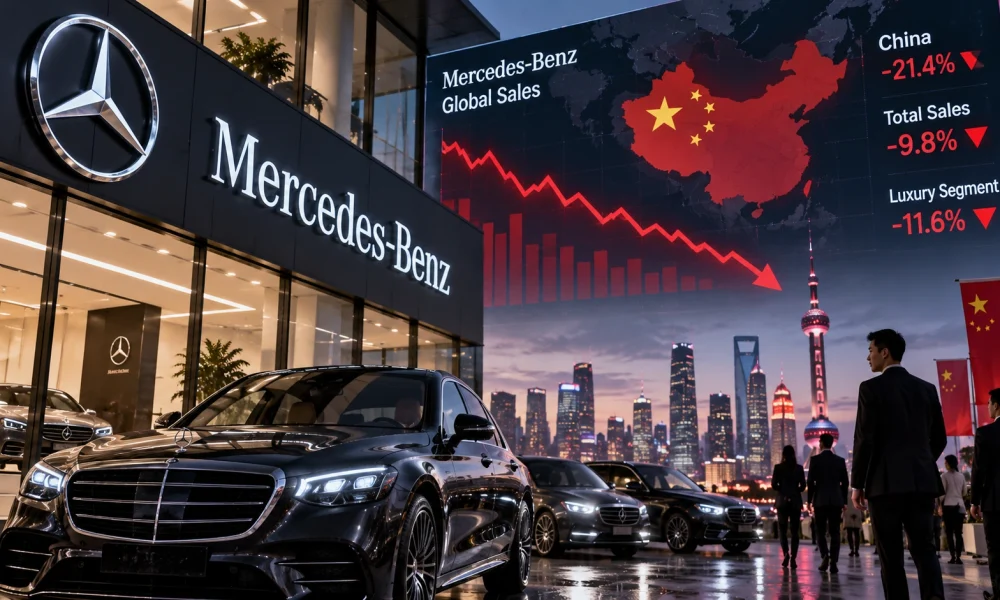
Mercedes-Benz is facing a difficult combination of weaker Chinese demand and an increasingly competitive electric vehicle market, with global sales in its core passenger-car business falling 8% in the third quarter of 2026.
The German luxury manufacturer reported the decline on October 7, while also pointing to a significant increase in electric vehicle deliveries. EV sales rose 52% compared with the same period last year, showing that consumer demand has not disappeared but is increasingly shifting toward different types of vehicles.
The figures offer an important snapshot of the transformation taking place across the global automotive industry.
For decades, China was one of the most important growth engines for European luxury carmakers. Mercedes-Benz, BMW and Volkswagen built extensive production and sales networks in the country, benefiting from the rapid expansion of China’s middle and upper classes.
That environment has changed.
China is no longer an easy growth market
Chinese consumers are becoming increasingly selective, while domestic manufacturers have become significantly more competitive.
Brands such as BYD and other Chinese electric vehicle companies have developed products that compete directly with established European manufacturers on technology, price and software.
The pressure is particularly strong in electric vehicles.
Chinese companies have built expertise across batteries, vehicle software and digital interfaces, allowing them to move quickly when introducing new models.
European luxury brands still possess enormous advantages in brand recognition, engineering and global distribution.
But those advantages are no longer sufficient on their own.
Electric sales provide a positive signal
Mercedes-Benz’s 52% increase in EV sales is an important part of the story.
The company is clearly attracting more customers to electric models, even while total vehicle sales are falling.
That suggests the transition toward electric mobility continues despite economic uncertainty.
However, electric vehicles also create new competitive challenges.
Consumers increasingly compare cars not only on design and performance but also on software, charging technology, battery range and digital services.
Traditional luxury brands therefore have to compete in areas that were less important when mechanical engineering was the main differentiator.
The luxury market is changing
Luxury carmakers are also facing a broader change in consumer behaviour.
High interest rates, weaker economic confidence and uncertainty about employment can influence major purchases.
A premium car is one of the first discretionary purchases that some households may postpone when economic conditions become uncertain.
In China, the situation is even more complicated because domestic manufacturers are offering increasingly sophisticated alternatives at lower prices.
European manufacturers need to rethink their strategy
The challenge for Mercedes-Benz is therefore not simply to sell more electric cars.
The company must determine where those cars should be produced, how they should be priced and which markets will provide future growth.
That requires major investments.
Factories have to be adapted.
Software capabilities have to improve.
Battery supply chains must become more secure.
And manufacturers need to keep premium customers loyal while competing against companies that can often operate at lower costs.
The global auto industry is entering a new phase
Mercedes-Benz’s latest figures demonstrate that the automotive transition is no longer simply about replacing petrol engines with electric motors.
It is a much broader restructuring of the industry.
China’s role is changing from being primarily a major consumer market to becoming one of the most important sources of automotive competition.
Electric vehicles are moving from an emerging category into the mainstream.
And traditional luxury brands are being forced to prove that their reputation still carries enough value in a market where technology increasingly determines the customer experience.
For Mercedes-Benz, the next challenge will be turning strong EV growth into overall sales growth.
For the wider industry, the lesson is even clearer: the global automotive hierarchy is becoming more competitive, and no major brand can assume that its traditional strengths will guarantee future growth.