Chinese Automakers Are Rewriting the Global Auto Show, and Europe Is Watching Closely
The global automotive industry is entering a new phase of competition, and one of the clearest signs can be seen at international motor shows.
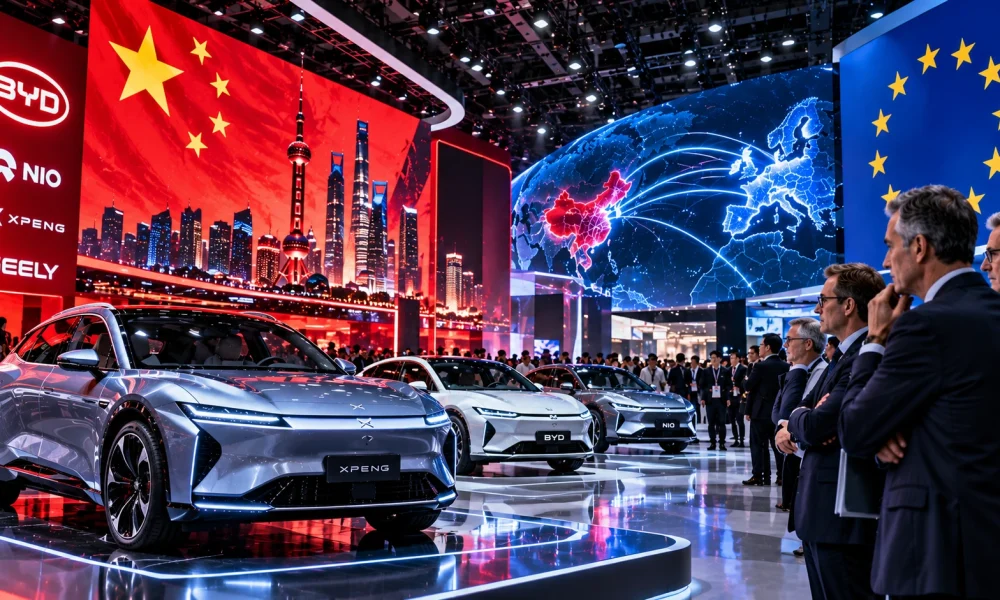
Chinese car manufacturers are becoming increasingly prominent at events that were once dominated by European, Japanese and American brands. Reuters reported on October 6 that around 20 Chinese brands are expected to participate in the upcoming Paris Auto Show, highlighting the speed at which China’s automotive industry is expanding its international presence.
The development is more than a question of exhibition space.
Auto shows have traditionally been used by established manufacturers to demonstrate new technologies, introduce flagship vehicles and reinforce their brands. The growing presence of Chinese companies shows that the balance of power within the global automotive industry is changing.
From domestic growth to global expansion
Chinese carmakers have spent years developing their domestic market.
Companies such as BYD, SAIC and Geely have built large production networks and developed increasingly sophisticated electric vehicles.
The next step is international expansion.
Chinese manufacturers are now looking beyond their home market because the European, Latin American and other international markets offer opportunities for additional growth.
Their competitive advantage is not based solely on price.
Many Chinese manufacturers have developed strong expertise in batteries, electric powertrains, digital interfaces and vehicle software.
That combination allows them to compete in segments that were once controlled almost exclusively by established Western and Japanese brands.
Latin America is already changing
The shift is particularly visible in Latin America.
Chinese brands have rapidly increased their market share in countries such as Argentina.
Reuters reported that Chinese automakers increased their share of the Argentine market from roughly 2% to 10% in less than a year.
That pace demonstrates how quickly consumer behaviour can change when new products combine competitive prices with modern technology.
Argentina is also becoming a strategic manufacturing location.
Toyota plans to invest around $1.34 billion in electric vehicle production in the country, while other manufacturers are examining ways to strengthen regional production.
European manufacturers face a difficult choice
European companies are under pressure from several directions simultaneously.
They are investing heavily in electrification while dealing with high production costs and increasingly complex regulations.
At the same time, Chinese competitors are arriving with electric models that can often be produced at lower cost.
European companies therefore have to decide how aggressively to reduce prices without damaging their margins.
The challenge is particularly difficult for brands that have traditionally positioned themselves around premium design and engineering.
The US market may become the next battleground
The competition is not limited to Europe.
Ford CEO Jim Farley has warned about the potential expansion of Chinese manufacturers into the US market.
American policymakers are already dealing with concerns over supply chains, industrial competitiveness and national security.
The automotive industry therefore sits at the intersection of technology and geopolitics.
Electric vehicles depend on batteries, semiconductors and critical minerals, all of which are strategically important.
Auto shows reflect a changing industry
The increasing Chinese presence at major motor shows is therefore symbolic.
It demonstrates that global automotive competition is no longer simply a contest between traditional manufacturers.
The most important companies of the next decade may come from countries that were previously considered secondary players.
European and American manufacturers still have significant advantages, including established brands, dealer networks and decades of engineering experience.
But the speed of Chinese expansion means those advantages can no longer be taken for granted.
The global automotive industry is entering a period in which technology, cost and production scale are becoming increasingly important.
The auto show floor is simply where that transformation becomes visible to consumers.