India’s Election Commission Faces Growing Political Pressure as Rahul Gandhi Leads New Protest
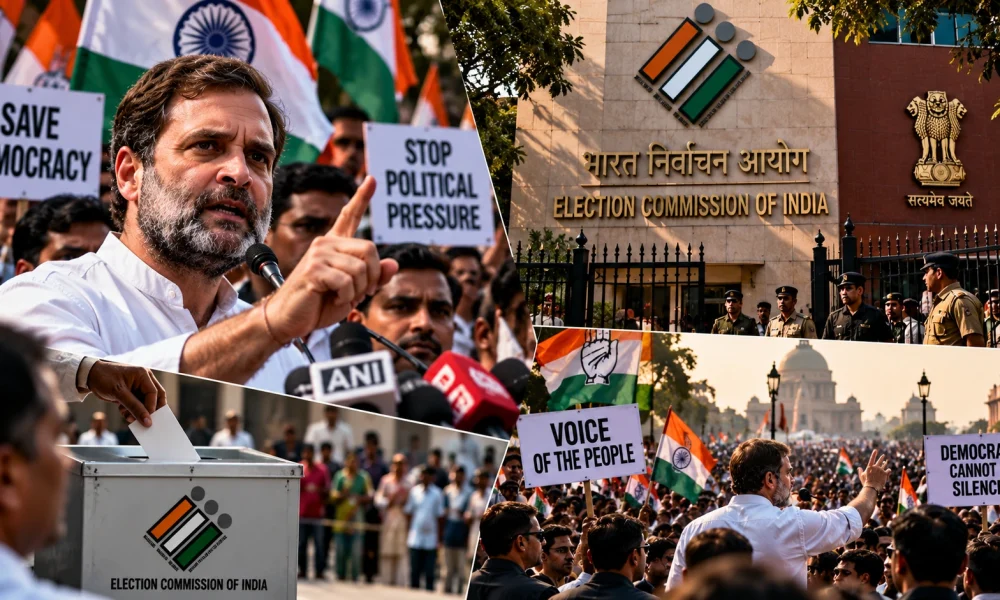
India’s political tensions intensified on October 6 after police broke up an opposition protest near the Election Commission headquarters and briefly detained Congress leader Rahul Gandhi and other lawmakers.
The protest was organised to demand the resignation of Chief Election Commissioner Gyanesh Kumar over allegations concerning the revision of voter lists. The Election Commission has rejected claims of political bias, while the governing Bharatiya Janata Party has dismissed the accusations.
The confrontation is significant because it comes during a period of growing political debate over the independence and functioning of India’s electoral institutions.
Opposition parties challenge the voter-list process
Opposition parties have accused the Election Commission of making changes to voter lists that they believe could benefit Prime Minister Narendra Modi’s government.
The allegations have not been accepted by the election authorities.
The Election Commission has defended its procedures and rejected accusations that it is acting in favour of the governing party.
The disagreement has nevertheless become a major political issue.
Rahul Gandhi increases pressure
Rahul Gandhi and other opposition lawmakers marched toward the Election Commission’s headquarters before staging a sit-in.
Police later intervened and detained several protesters.
The lawmakers were subsequently released.
For the opposition, the protest is being presented as a defence of democratic institutions and electoral integrity.
For the government and its supporters, the allegations are being portrayed as politically motivated.
The Election Commission is central to Indian democracy
India is the world’s largest democracy, and the Election Commission has a critical role in administering elections.
Its responsibilities include voter registration, electoral procedures and the conduct of national and state elections.
Confidence in the institution is therefore essential.
Disputes over voter lists are particularly sensitive because they affect who is able to participate in elections.
Political tensions extend beyond elections
The confrontation comes after other protests involving opposition parties and student groups.
Political tensions have also increased around issues such as education, employment and government policy.
The protests demonstrate that the government faces pressure not only from established opposition parties but also from younger political movements.
The government has a strong parliamentary position
Prime Minister Narendra Modi is currently serving his third term.
The governing BJP remains one of the most powerful political organisations in the country.
However, the government also faces criticism over economic inequality, employment and institutional questions.
The opposition is attempting to use these issues to build a stronger political challenge.
The debate over institutions matters
The disagreement over voter lists is important because it raises broader questions about institutional trust.
In democratic systems, political parties can disagree over policy.
But disputes over the administration of elections can have much deeper consequences because they affect confidence in the legitimacy of the political process itself.
That is why both sides have strong incentives to defend their positions.
The next phase will be watched closely
The immediate protest has ended, but the political dispute is unlikely to disappear.
The opposition is expected to continue demanding greater transparency, while the Election Commission is likely to defend its procedures.
The most important question is how voters interpret the controversy.
There is no single measure of political legitimacy.
It depends on institutions, procedures and public confidence.
For India, maintaining that confidence will remain crucial as the country prepares for future elections.