UK New Car Market Hits Its Strongest September Since 2017 as EVs and Chinese Brands Gain Ground
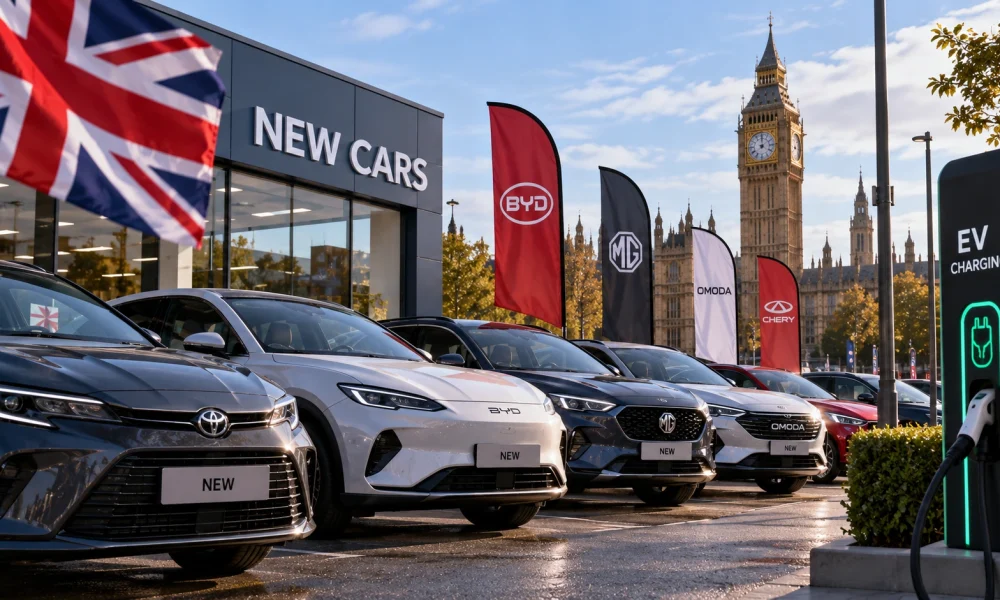
The United Kingdom recorded its strongest September for new car registrations since 2017, with sales rising 12% year on year.
The increase was supported by strong electric vehicle demand and the rapid expansion of Chinese automotive brands.
Electric vehicles continue to expand
Battery-electric vehicle registrations increased by 36.3% in September.
The growth comes despite continued debate over the pace of Europe’s transition away from internal combustion engines.
The UK market is increasingly demonstrating that demand for electric vehicles can grow even when the overall automotive environment remains challenging.
Chinese brands are becoming mainstream
One of the most notable developments was the performance of Chery’s Jaecoo 7.
The model led the UK’s September sales ranking, providing another indication that Chinese manufacturers are moving rapidly into European markets.
Chinese carmakers are expanding through a combination of competitive pricing, advanced technology and increasingly broad product ranges.
Their expansion is forcing established manufacturers to compete on both price and technology.
Petrol loses market share
Petrol vehicles accounted for 41.5% of UK new car registrations during the first nine months of the year.
That share has continued to decline as electric and hybrid models gain ground.
The transition is particularly significant for manufacturers because the change affects not only vehicle design but also supply chains, manufacturing plants and dealer networks.
Global trends point in the same direction
Data from the first half of 2026 indicates that internal combustion vehicles accounted for less than half of global new vehicle sales for the first time.
That does not mean combustion engines are disappearing immediately.
Instead, it indicates that electrified powertrains have become a major part of the global automotive market.
European manufacturers face multiple pressures
European brands are dealing with the cost of electrification, competition from China and weaker demand in some major markets.
Volvo Cars, for example, issued a profit warning on October 2 after third-quarter deliveries fell 11%, citing difficult conditions in China and slower recovery in the United States.
At the same time, Volvo’s EV sales increased 29% in the quarter.
The contrast illustrates the complexity of the transition.
Electric vehicles can grow rapidly while manufacturers still experience financial pressure.
The UK market therefore offers an important snapshot of the industry’s transformation: overall demand is recovering, EVs are gaining share and Chinese brands are becoming increasingly visible.