Amazon and Walmart Face New Pressure to Clean Up Online Marketplaces
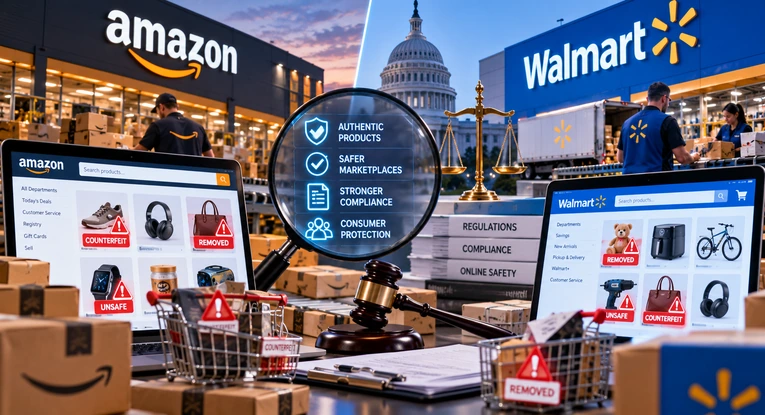
Amazon and Walmart’s Flipkart are reviewing security-camera listings on their Indian online marketplaces after concerns emerged over hundreds of internet-connected surveillance devices that may not have complied with local certification requirements.
The review highlights a growing problem for global e-commerce platforms: marketplaces are no longer judged only on the products they sell, but also on whether third-party sellers comply with national safety and security rules.
Indian authorities require certain electronic products to meet mandatory standards before being sold to consumers. Reports about unlicensed security cameras have therefore triggered additional scrutiny of marketplace listings.
The issue is particularly sensitive because security cameras are not ordinary consumer electronics.
They can capture video, connect to networks and potentially expose private information if poorly designed or insecure.
Marketplace responsibility is changing
For years, large e-commerce platforms argued that they were primarily intermediaries connecting consumers with third-party sellers.
That model is increasingly difficult to maintain.
Regulators and consumers want platforms to take greater responsibility for what appears on their websites.
The problem becomes more complicated when products are imported from multiple countries and sold by thousands of independent merchants.
A platform can theoretically host millions of listings.
Checking every product manually is almost impossible.
Technology can make the problem worse
The rise of connected devices has increased the potential consequences of poor-quality products.
A defective kitchen appliance can be dangerous.
An insecure internet-connected camera can potentially expose private spaces.
That difference is important.
Consumers buying smart-home technology increasingly need to trust not only the retailer but also the manufacturer, software provider and seller.
India is tightening oversight
India has been strengthening regulation of electronics and connected devices as the country’s digital economy expands.
The government wants to encourage technology adoption while also protecting consumers and national security.
The security-camera issue fits into a broader debate over imported technology.
Some devices may not meet technical standards.
Others may create cybersecurity concerns.
Authorities therefore have an interest in ensuring that products sold through major platforms comply with local rules.
Amazon and Flipkart face a difficult balancing act
The platforms need to protect consumers without making their marketplaces too restrictive.
Third-party sellers provide enormous product variety.
That variety is one of the biggest advantages of online marketplaces compared with traditional retail.
But it also creates enforcement problems.
If platforms remove too many listings, sellers may complain that the rules are unfair.
If they remove too few, regulators may accuse them of failing to protect consumers.
Artificial intelligence may become part of the solution
E-commerce platforms are increasingly using automated systems to identify suspicious listings.
AI can compare product descriptions, certifications and seller information at a scale that human teams cannot match.
That could make it easier to detect products that appear to violate local rules.
However, automated systems can also make mistakes.
A compliant product may be incorrectly removed, while a sophisticated seller may find ways to avoid detection.
Human oversight will therefore remain important.
The issue extends beyond India
The same problem is appearing in other major markets.
European and American regulators are also examining the responsibility of online marketplaces for products sold by third-party merchants.
The trend suggests that e-commerce platforms are becoming closer to traditional retailers in terms of regulatory expectations.
Consumers increasingly expect a marketplace to provide a minimum level of assurance that products are legitimate and safe.
Trust is becoming a competitive advantage
The future of online commerce will depend heavily on trust.
Price and delivery speed remain important, but consumers also want confidence that the products they buy are authentic, legal and safe.
Amazon and Walmart have enormous resources to address these problems.
Smaller marketplaces may struggle more.
The Indian security-camera case therefore illustrates a much larger transformation in e-commerce.
Online marketplaces are moving from being simple digital shopping centres toward becoming regulated commercial infrastructures.
The companies that can build reliable systems for checking sellers and products may gain an important competitive advantage as governments around the world increase oversight of digital commerce.