Sports Car Market Splits Between Raw Performance and a New Era of Technology
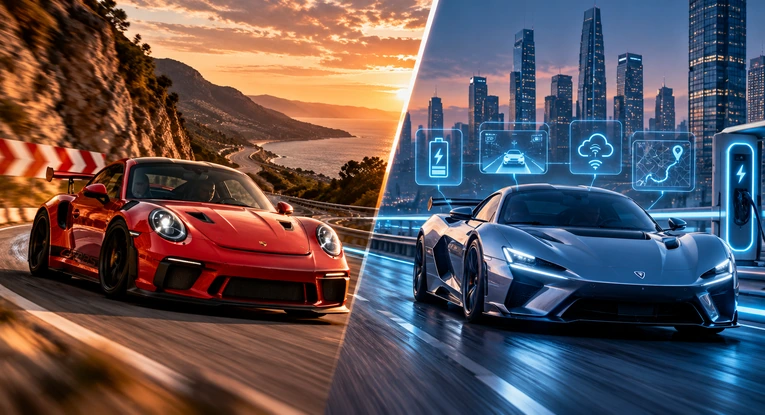
The global sports car market is entering a period of unusual change as manufacturers attempt to balance traditional driving excitement with increasingly sophisticated technology.
The latest debate centres on a fundamental question: how much technology can be added to a performance car before it changes the experience that made sports cars attractive in the first place?
More power is no longer the only goal
For decades, sports car development was largely associated with engine power, acceleration and top speed.
That formula is becoming more complicated.
Modern performance cars increasingly rely on electric assistance, advanced software, active aerodynamics and sophisticated driver-assistance systems.
The result is that some new sports cars can deliver performance that would have been considered extraordinary only a few years ago.
But more performance has also created a new problem for manufacturers.
Technology changes the driving experience
Electronic systems can improve acceleration, cornering and stability, but they can also reduce the sense of mechanical connection between the driver and the car.
That has created a divide within the sports car market.
Some buyers are attracted to increasingly powerful and technologically advanced models, while others are searching for simpler cars that prioritise steering feel, sound and driver involvement.
The debate is becoming particularly relevant as manufacturers move toward electrification.
Electric power changes the formula
Electric motors can deliver instant torque and extremely rapid acceleration.
However, battery weight remains one of the biggest challenges for sports car engineers.
A heavier vehicle can feel very different from a lightweight sports car, even when its acceleration figures are superior.
This is encouraging manufacturers to invest in lighter materials, more sophisticated chassis systems and new battery technologies.
The return of the analogue experience
At the same time, demand for older and more analogue sports cars remains strong among enthusiasts.
Cars with manual transmissions, naturally aspirated engines and limited electronic intervention are increasingly viewed as desirable collector vehicles.
That has created an unusual situation in which older performance cars can coexist with some of the most technologically advanced vehicles ever produced.
A divided market
The sports car industry may therefore be moving toward two distinct directions.
One side will continue to pursue maximum performance through electrification and advanced technology.
The other will focus on emotional appeal, lightweight construction and traditional driving characteristics.
Both approaches can coexist, but they appeal to different buyers.
The future of the sports car may not be defined by a single technology.
Instead, it could be defined by the growing difference between cars designed to achieve the fastest possible numbers and cars designed to make driving itself the main attraction.