Microsoft and Nvidia Prepare New AI Laptop as Computing Moves Closer to the User
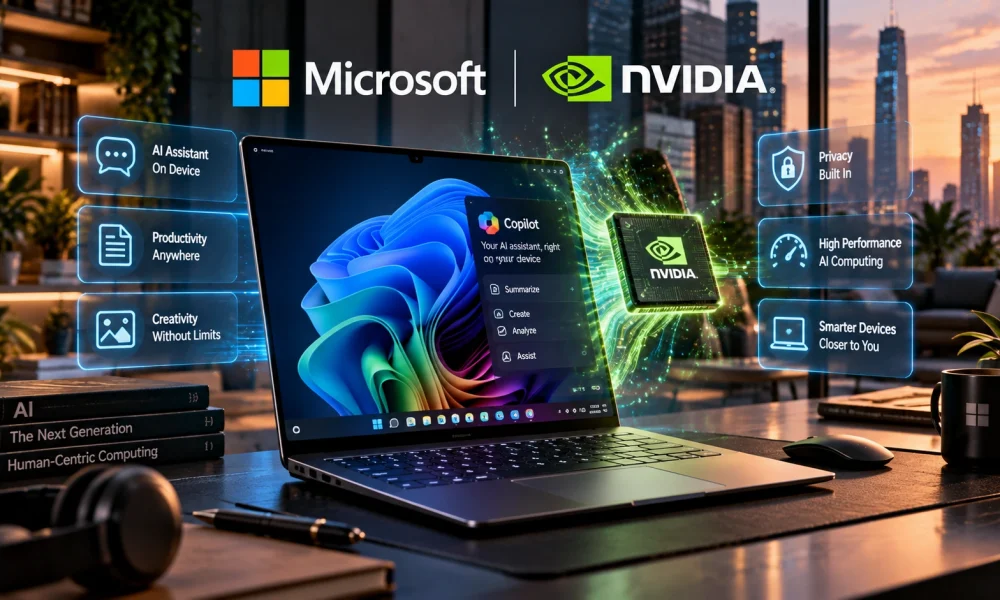
Microsoft and Nvidia are preparing to unveil a new AI-powered laptop that could mark an important shift in how artificial intelligence is delivered to consumers.
The Surface Laptop Ultra is expected to combine Microsoft’s software with Nvidia’s RTX Spark chips, allowing more advanced AI tasks to run directly on the device rather than relying entirely on cloud computing. Reuters reported on October 7 that the companies are preparing the announcement at an event in San Francisco.
The development comes at a crucial moment for the technology industry.
AI has largely been associated with enormous cloud data centres.
The next stage could move more of that computing power onto personal devices.
Why local AI matters
Most advanced AI services currently depend on cloud infrastructure.
A user sends a request to a remote server.
The server processes the request.
The result is returned to the device.
Local AI changes that model.
If a sufficiently powerful computer can perform the task itself, the user may not need to send all information to the cloud.
That could improve speed and privacy.
Nvidia wants a larger role in PCs
Nvidia has dominated the market for AI data-centre chips.
Its GPUs are used to train and operate many of the world’s most advanced AI systems.
The consumer PC market is different.
Intel and AMD have historically dominated processor technology, while Nvidia has primarily focused on graphics and AI acceleration.
A successful AI PC strategy could therefore open a new market for Nvidia.
Microsoft wants AI to become a normal computer function
Microsoft has invested heavily in artificial intelligence.
The company has integrated AI into Windows and its productivity software.
The next step is making AI capabilities feel like a normal part of the PC.
Users could potentially run coding assistants, research tools and autonomous agents directly on their computers.
That would change how people interact with software.
Hardware costs remain a problem
The biggest challenge is cost.
AI-capable chips require significant computing resources.
Memory prices are also rising as demand from data centres increases.
That could make advanced AI laptops significantly more expensive than traditional computers.
If only wealthy consumers can afford them, adoption could remain limited.
Local AI could improve privacy
There is also a strong privacy argument.
Sensitive information could potentially be processed locally rather than uploaded to a cloud service.
That could be important for businesses dealing with confidential documents.
However, local processing does not automatically guarantee security.
AI agents running on personal computers can also create new vulnerabilities if they are given extensive access to files and applications.
Autonomous agents are the next challenge
AI is moving from systems that answer questions toward systems that perform tasks.
An AI agent could write code, organise files, manage schedules or interact with software.
That makes the security problem more complicated.
A powerful local AI agent may have access to highly sensitive information.
Users will need better controls over what these systems are allowed to do.
The PC market could change
If local AI becomes successful, the traditional computer upgrade cycle could change.
Consumers may begin replacing devices not because they need more storage or a faster processor, but because they want more powerful AI capabilities.
That could create a new growth cycle for the PC industry.
The future may be hybrid
The most likely outcome is not that cloud AI disappears.
Instead, consumers may use both local and cloud systems.
Simple or sensitive tasks could run locally.
More demanding workloads could be sent to data centres.
The Microsoft-Nvidia project is therefore important because it points toward a more distributed AI ecosystem.
Artificial intelligence may soon be present not only in the cloud but inside the computer sitting on a user’s desk.