Airlines Expand Global Connections as Gulf Routes Become Even More Important
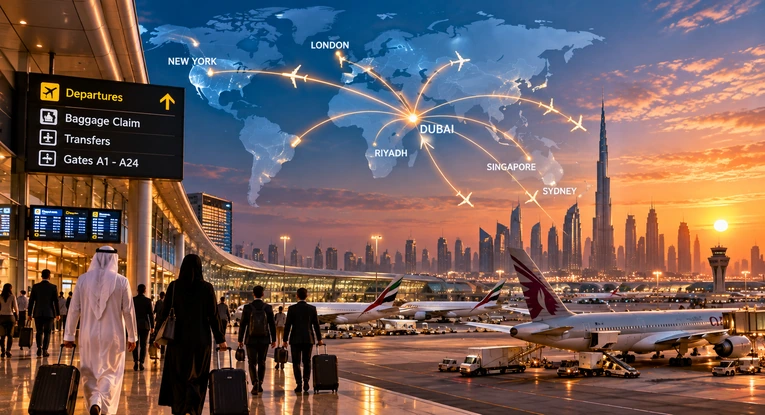
The international aviation industry continues to expand its network of connections, with Gulf carriers playing an increasingly important role in linking Europe, Asia and the Middle East.
One of the latest developments is Gulf Air’s new direct service between Bahrain and Kuala Lumpur, launched on October 7 with a Boeing 787-9 Dreamliner. The new route strengthens Kuala Lumpur International Airport’s connectivity with the Middle East and gives Gulf Air another important link between Southeast Asia and its Bahrain hub.
The route is significant because aviation is increasingly organised around global hubs.
Gulf airports have become strategic centres
Doha, Dubai, Abu Dhabi and Bahrain have developed into major international connecting points.
Their geographical position allows airlines to connect Europe with Asia, Africa and Australia.
This has changed global aviation.
Travellers who once relied heavily on European hubs can now connect through the Gulf.
Airlines are rebuilding networks around demand
New routes are not launched simply because aircraft are available.
Airlines analyse tourism, business travel, population growth and connecting demand.
Kuala Lumpur is an attractive destination because Malaysia has a large tourism industry and strong business connections across Asia.
Bahrain offers access to the Gulf market and connections beyond the country itself.
Long-haul travel remains resilient
The continued expansion of international routes shows that demand for long-distance travel remains strong.
Consumers continue to spend on holidays and international experiences despite economic uncertainty.
Business travel has also recovered in important markets.
Airports are competing too
Airports increasingly compete to attract airlines.
A new route can create substantial economic benefits.
It can bring tourists.
It can support hotels and restaurants.
It can improve business connections.
It can also strengthen the airport’s position as a regional hub.
Travel is becoming more connected
Modern tourism increasingly depends on networks rather than individual destinations.
A traveller may begin a journey in Europe, connect through Bahrain and arrive in Southeast Asia.
Airlines therefore need to coordinate schedules carefully.
A single new route can become valuable because it creates dozens of possible connections.
Aircraft technology matters
The Boeing 787-9 used by Gulf Air is an example of how modern aircraft are supporting new long-distance routes.
Newer aircraft are generally more fuel-efficient than older wide-body models.
That makes routes that might previously have been economically difficult more viable.
Fuel prices remain an important risk, however.
The current rise in oil prices could increase airline operating costs.
Tourism competition is intensifying
Destinations are also competing for travellers.
Countries want visitors to stay longer and spend more.
That has encouraged investment in hotels, attractions and tourism infrastructure.
Asia remains particularly important because of its large population and growing middle class.
Sustainability remains a challenge
Aviation faces continuing pressure over emissions.
More efficient aircraft help reduce fuel consumption per passenger, but the growth in global flying can offset some of those gains.
Airlines are therefore investing in sustainable aviation fuel and operational efficiency.
The transition is expensive and will take time.
The next phase of aviation
The expansion of Gulf Air’s Kuala Lumpur route illustrates the direction of global aviation.
Airlines are building increasingly interconnected networks around major hubs.
Passengers want more direct options and reliable connections.
Airports want to attract more routes.
Tourism destinations want easier access to international visitors.
At the same time, the industry must deal with fuel costs, infrastructure constraints and environmental pressure.
For travellers, the result is a world that is becoming more connected.
For airlines, the challenge is ensuring that this connectivity remains economically sustainable.