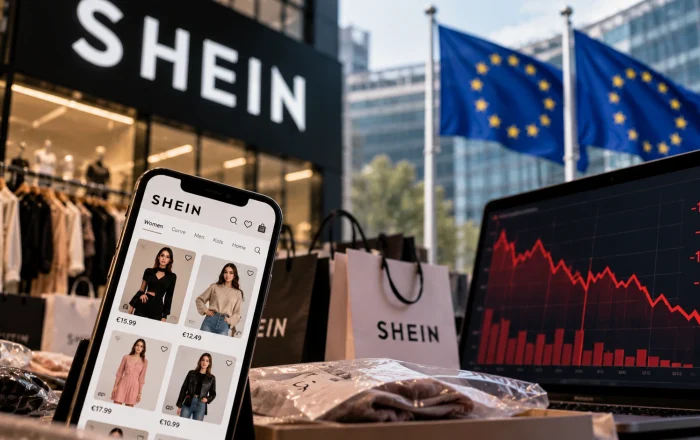
Temu, Shein and AliExpress Capture More Than 90% of EU Online Spending That Leaves the Bloc

European consumers spent €55.1 billion on physical goods from online stores outside the European Union in 2025, and more than 90% of that spending went to three Chinese platforms: Temu, Shein and AliExpress.
The figures, published this week by ECDB and reported by Ecommerce News, provide a clear picture of how strongly Chinese e-commerce platforms have established themselves among European consumers.
The numbers are particularly significant because the European Union is simultaneously changing the customs framework governing low-value imports.
€49.7 billion went to three platforms
According to the ECDB analysis, European consumers spent €49.7 billion on Temu, Shein and AliExpress during 2025.
That represented 90.2% of all online spending by European consumers that went to Chinese online stores.
The United States accounted for 4.8% of spending outside the EU, while the United Kingdom accounted for 4.6%.
The figures show how difficult it is for smaller international marketplaces to compete with the scale of the three Chinese platforms.
Most European spending still stays inside Europe
Despite the rapid expansion of cross-border platforms, the majority of European online spending remains within the EU.
Consumers spent approximately €421 billion online on physical goods in 2025, with 86.9% of that spending remaining inside the bloc.
The share leaving the EU was 13.1%.
That percentage has nevertheless increased substantially. In 2020, only 2.3% of European online spending on physical goods went to stores outside the EU.
ECDB expects the share to rise to 15.2% in 2026.
Customs rules are changing the economics
The growth of cross-border e-commerce has become a major issue for European regulators.
From July 1, 2026, the EU introduced a temporary €3 customs duty on low-value consignments worth up to €150 imported from outside the bloc.
The measure replaced the previous customs duty exemption and is scheduled to remain in place until July 2028, after which the permanent customs regime will apply.
The European Commission says the reform is partly a response to the huge increase in low-value imports. In 2025, around 5.9 billion low-value e-commerce items entered the EU, roughly four times the volume recorded in 2022.
Platforms face a different competitive environment
The new customs rules could alter the economics of ultra-low-cost cross-border commerce.
Platforms built around inexpensive products shipped individually from Asia must now account for additional customs costs and more complex compliance requirements.
That does not necessarily eliminate their price advantage.
Large marketplaces can adjust logistics, warehouse locations and pricing strategies. But the days when millions of low-value parcels could enter Europe under a largely simplified customs regime are ending.
Local retailers get a more level playing field
European retailers have argued for years that direct imports from outside the EU created an uneven competitive environment.
A European retailer importing products in bulk already had to comply with customs requirements, product standards and other obligations.
The new rules bring more of those requirements into the cross-border marketplace model.
For consumers, the changes may mean higher prices for some products. For European businesses, they could reduce part of the cost advantage enjoyed by platforms specialising in direct-to-consumer imports.
The cross-border market is not disappearing
The underlying demand remains strong.
European consumers continue to look for low prices, wide product selection and fast delivery.
The new environment is therefore likely to encourage platforms to adapt rather than retreat.
Temu, Shein and AliExpress have already demonstrated their ability to change logistics and fulfilment strategies rapidly.
The next phase of European e-commerce will therefore be less about whether consumers buy from China and more about how those purchases are delivered, taxed and regulated.