AI Shopping Agents Force Marketers to Rethink How Brands Are Discovered Online
Artificial intelligence is beginning to change not only how consumers search for products, but also how brands compete for visibility.
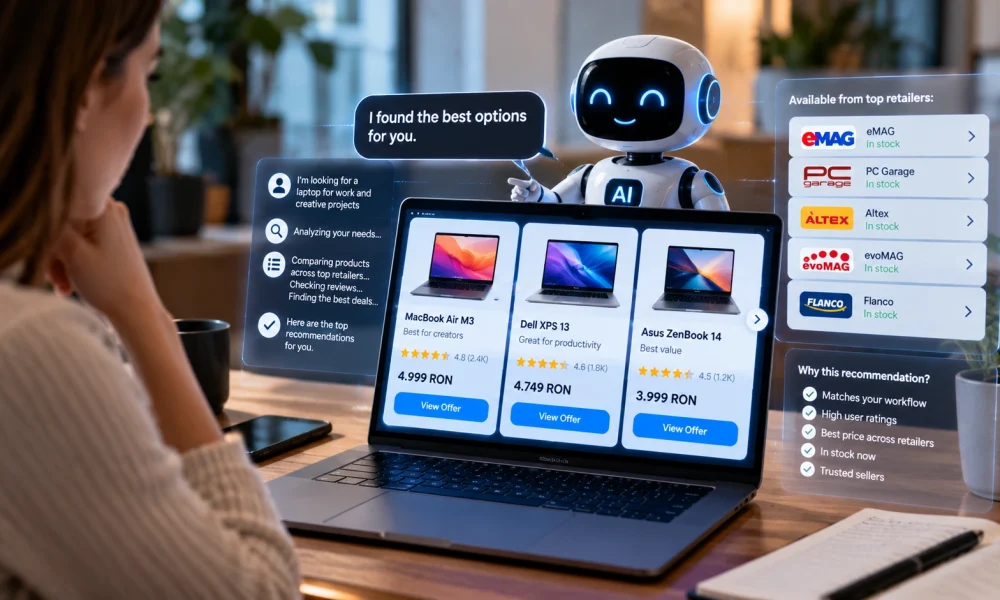
Retailers and technology companies are now testing AI agents capable of discovering products, comparing offers and potentially completing purchases on behalf of consumers.
The development is creating a new marketing question: what happens when the first interaction with a brand is no longer a human browsing a website?
Search is becoming conversational
Traditional digital marketing was built around search engines, keywords, social media and paid advertising.
AI shopping agents introduce another layer.
Instead of searching for “running shoes under $150”, a consumer could ask an AI assistant to find several suitable options and complete the purchase.
The agent then becomes a filter between the consumer and the retailer.
That changes the importance of product data, pricing, reviews, availability and brand reputation.
Retailers are divided
Some retailers are actively preparing for agentic commerce.
QVC and HSN have been providing product catalogues to AI companies, while companies including Gap, Walmart and Best Buy have announced partnerships involving AI shopping systems.
Other retailers are taking a more cautious approach.
Tapestry, the owner of Kate Spade and Coach, allows AI agents to browse but has not opened the purchasing function. Amazon and Kohl’s have blocked certain shopping agents.
Marketing budgets could move
If consumers increasingly delegate product discovery to AI, traditional advertising could lose some of its influence in certain categories.
Brands will need to make their product information machine-readable and accurate.
Price, availability, technical specifications and reviews could become as important for AI visibility as keywords once were for search engines.
This could create a new discipline around “AI discoverability”, combining SEO, product information management and brand strategy.
The human brand still matters
AI agents can compare products, but consumers still care about trust, reputation and identity.
That means brands cannot simply optimise for algorithms.
They also need to maintain a strong direct relationship with customers through content, community and customer experience.
The transition to agentic commerce is still at an early stage. Consumer adoption remains uncertain, and many shoppers may continue to prefer controlling purchases themselves.
But marketers are already facing a new reality: the next search engine may not be a website at all.
Sources: Wall Street Journal, Campaign Asia, AdTech Today, major retail companies.