Mega-Mergers Return as Paint Industry Prepares for a $25 Billion Deal
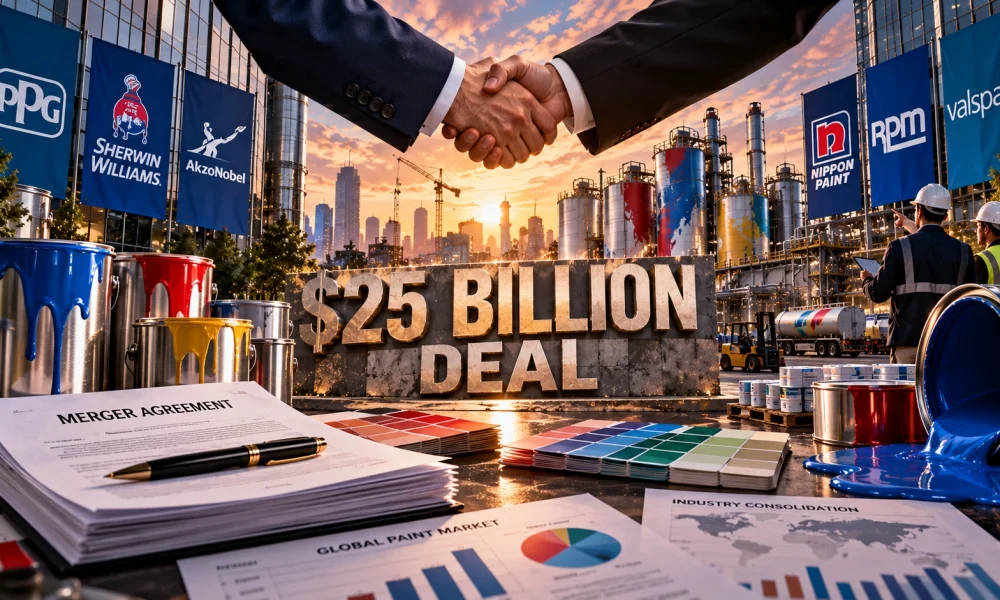
The global paints and coatings industry is approaching one of its most important consolidations in years.
AkzoNobel, the manufacturer behind the Dulux brand, and US-based Axalta Coating Systems are expected to receive conditional approval from European authorities for their proposed merger, valued at around $25 billion.
The European Commission has been examining the transaction from a competition perspective, with one of the main conditions involving the sale of Axalta’s automotive refinishing business.
Why the merger matters
At first glance, a transaction between two paint manufacturers may seem distant from consumers’ everyday lives.
In reality, the industry plays an important role across numerous sectors, from automobiles and construction to infrastructure, manufacturing and consumer goods.
Industrial coatings protect surfaces against corrosion, wear and weather conditions and are an important component of global industrial supply chains.
By combining their operations, the two companies are seeking greater economies of scale and a stronger position at a time when production costs and trade uncertainty have increased.
Europe is examining the competitive impact
The European Commission is particularly concerned about overlaps between the two companies’ businesses.
Some initial concerns involving the powder coatings segment have been addressed, while Axalta’s automotive refinishing business remains the main competition issue.
The companies are expected to formally submit the proposed remedies, while the review process could extend the Commission’s original deadline.
An industry under pressure
The transaction comes at a time when industrial manufacturers are trying to control costs.
Raw materials, energy, transportation and changing trade conditions have affected margins across the sector.
US tariffs have added another layer of uncertainty for companies operating across several continents.
Consolidation can allow manufacturers to reduce certain costs and negotiate more efficiently with suppliers.
But greater size does not automatically guarantee better results.
Integrating two global companies can be complex, particularly when factories, customers and commercial systems differ.
Mergers are becoming a defensive strategy
AkzoNobel and Axalta are part of a broader trend.
Across many industries, companies are considering mergers and acquisitions not only as a way to grow, but also as a way to protect margins.
In a volatile economic environment, scale can provide significant advantages.
Larger companies can spread technology investments across greater volumes, optimise logistics networks and access international markets more easily.
Regulators are becoming more cautious
Consolidation also raises questions about competition.
If a small number of companies control important parts of an industry, industrial customers may have fewer alternatives.
That is why European and US regulators are examining major mergers more closely.
In the AkzoNobel-Axalta case, the sale of the automotive refinishing business is an example of the compromise between corporate ambitions and regulatory concerns.
What comes next
If the transaction receives final approval, the combined company will become a significantly stronger player in the global coatings industry.
For investors, the case is also important because it shows how industrial companies are responding to an environment of higher costs and greater trade uncertainty.
For the sector, the message is even clearer.
Consolidation is no longer simply a strategy for expansion. In many industries, it is becoming a tool for remaining competitive in a more expensive and fragmented global economy.