Italy Changes Its Electoral Rules Ahead of the Next Election, Putting Pressure on the Entire Political Landscape
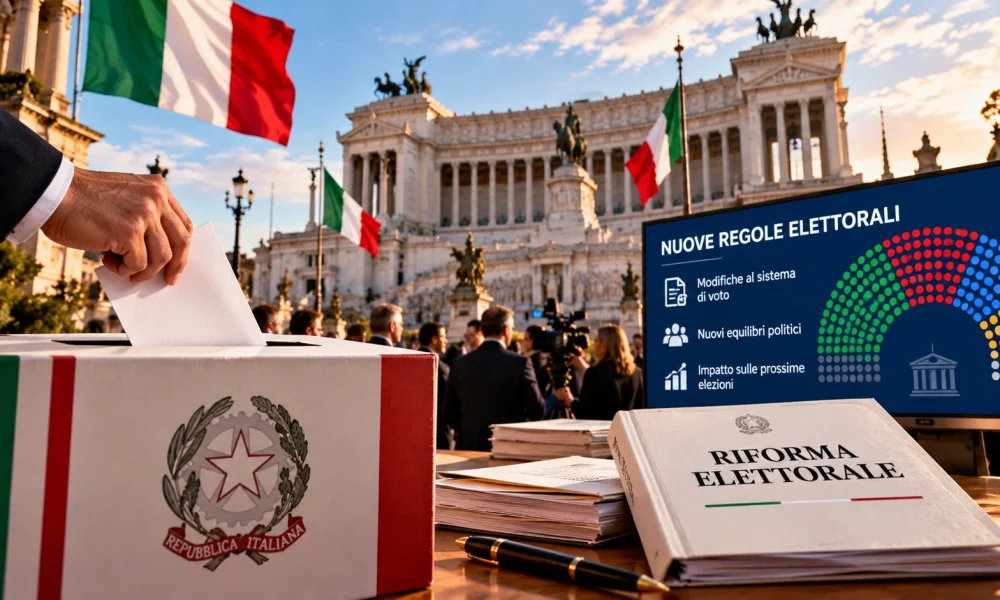
Italy’s parliament has approved a major electoral reform championed by Prime Minister Giorgia Meloni, establishing a new system that will shape next year’s national election.
The new law introduces a fully proportional electoral system combined with a majority bonus for an alliance that exceeds 42% of the vote. The reform was approved by 227 votes to 164 after months of political disputes.
How the system is changing
Italy’s previous electoral system combined proportional representation with constituencies in which the winning candidate took the seat.
The new law moves to a proportional system.
To avoid excessive parliamentary fragmentation, however, the alliance that exceeds 42% of the vote will receive a majority bonus of 70 seats in the Chamber of Deputies and 35 in the Senate.
The bonus is capped to prevent an excessively large majority.
The government says the goal is stability
Giorgia Meloni argues that the reform is designed to make it easier to form a stable government.
The argument is that a system favouring broad alliances can reduce parliamentary fragmentation.
Italy has historically experienced numerous governments and fragile coalitions.
Supporters of the reform say a system that allows a political bloc to obtain a functional majority could reduce instability.
The opposition is challenging the reform
Centre-left parties argue that the new system could favour the current governing coalition.
Critics say changing the rules before an election can benefit parties already in power.
At the same time, the reform could produce different outcomes depending on how opposition parties organise themselves.
Parties must identify their leadership
One of the most important elements is the requirement for each coalition, or each party running separately, to indicate a candidate for prime minister before the election.
This places particular pressure on the opposition.
The Democratic Party and the 5-Star Movement do not have the same position on who should lead a potential opposition coalition.
Opposition unity becomes crucial
The new system rewards broad alliances.
As a result, parties seeking to challenge the conservative bloc will need to decide whether they can cooperate.
The issue is not purely electoral.
There are also differences over foreign policy, including support for Ukraine.
The system could produce unexpected results
An important point is that the reform does not guarantee a permanent advantage to one political side.
If the opposition succeeds in building a broad alliance and exceeds the necessary threshold, the majority bonus could work in its favour.
That is why the real impact of the reform will become visible only during the election campaign.
Italy enters a new political phase
The reform comes after almost four years of Meloni’s government and at a time when Italy’s political system is being reorganised.
For voters, the new system makes coalition choices more important.
For political parties, negotiations over candidates and leadership will become decisive.
For European observers, Italy remains one of the European Union’s most important economies and political powers.
Next year’s election will show whether the reform produces the stability promised by its supporters or creates new tensions within an already fragmented political system.