Greece Intensifies Crackdown on Illegal Gambling and Targets Influencers
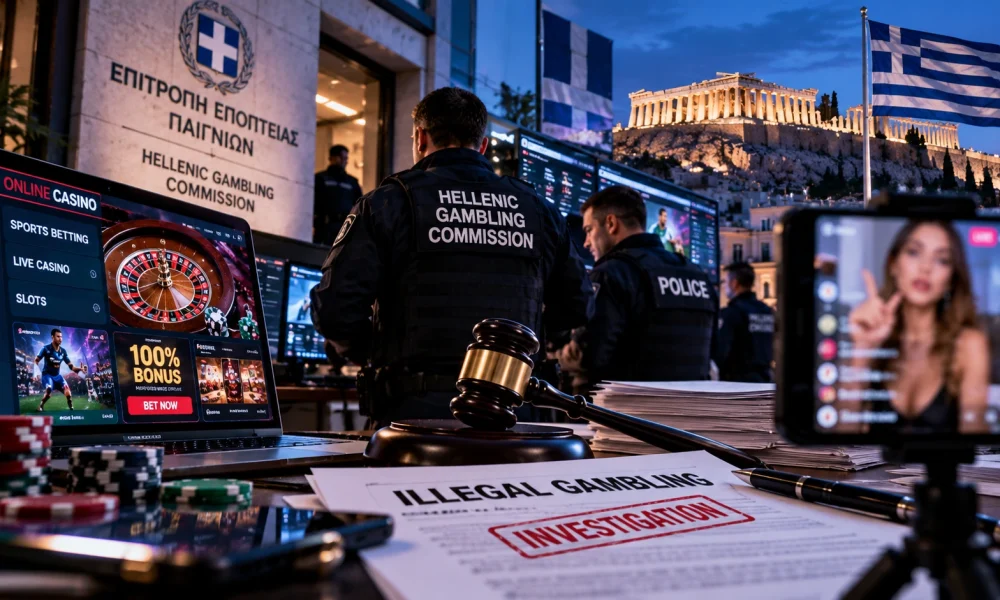
Greek authorities have entered a new phase in their fight against illegal gambling, filing criminal complaints against 18 influencers accused of promoting unauthorised gambling activities.
The case is important for the iGaming industry because it shows how regulatory responsibility is expanding beyond betting and casino operators.
Authorities estimate that around €1.8 billion was wagered on Greece’s illegal gambling market in 2025.
Influencers are becoming a regulatory issue
Gambling promotion has changed dramatically in recent years.
Operators no longer rely only on traditional advertising.
Influencers can reach large communities directly through social platforms.
Their messages can appear more personal than conventional advertisements.
That proximity to audiences is precisely what concerns regulators.
An influencer can make a gambling platform appear like an ordinary entertainment product.
Consumer protection is also at stake
Illegal gambling websites do not provide the same guarantees as licensed operators.
Age verification may be inadequate.
Self-exclusion tools may not exist.
Systems for monitoring problematic gambling behaviour may be absent.
Consumers may also have difficulty recovering funds or resolving disputes.
The illegal market competes with licensed operators
Licensed operators face significant costs.
They pay taxes.
They comply with customer verification requirements.
They implement anti-money-laundering procedures.
They provide responsible gambling tools.
Illegal operators can avoid some of those costs and offer more aggressive promotions.
That creates a major competitive problem for regulated markets.
Greece is not an isolated case
Authorities across Europe are also increasing pressure on illegal operators.
Regulators are attempting to block unauthorised websites and reduce advertising that can reach minors or vulnerable consumers.
In Switzerland, for example, the industry has begun exploring cooperation with digital platforms to identify promotion of unlicensed operators.
Social media is becoming the new battleground
One of the most difficult problems is that advertising can be integrated directly into content.
An influencer can promote a gambling service without the message looking like a traditional advertisement.
That makes enforcement more complicated.
Authorities have to determine who is responsible: the operator, agency, influencer or platform.
In many cases, responsibility may be shared between several parties.
The regulated industry also benefits from fighting illegal gambling
Licensed operators have something to gain from eliminating illegal competitors.
A better-controlled market can increase consumer trust.
At the same time, excessive regulation can push some customers toward unlicensed websites.
That creates one of the most difficult challenges for governments.
Rules must protect consumers without making the legal market so restrictive that it becomes uncompetitive.
A new standard for the industry
The Greek case shows that the iGaming industry is entering a phase in which advertising is being examined almost as closely as the gambling product itself.
Operators increasingly need to control not only the platforms they own, but also how their brands are promoted throughout the digital ecosystem.
For influencers, the message is equally important.
Promoting gambling can become an activity carrying serious legal responsibilities.