Uber Bets $2.3 Billion on Corporate Catering in Its Latest Expansion Beyond Ride-Hailing
Uber Bets $2.3 Billion on Corporate Catering in Its Latest Expansion Beyond Ride-Hailing
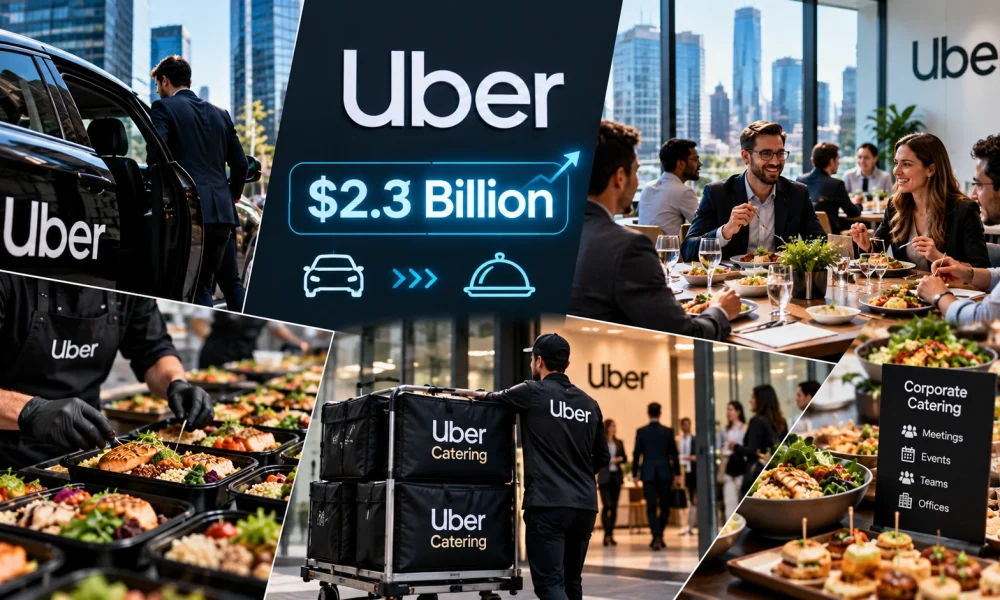
Uber is making a major move into the corporate food market with a $2.3 billion all-cash acquisition of US catering platform ezCater.
The transaction, announced on October 6, will bring together ezCater’s catering network with Uber Eats and Uber for Business, creating a broader platform for restaurants, caterers and corporate customers. The acquisition remains subject to regulatory approval and is expected to close in the coming months.
The deal is another example of Uber’s strategy of expanding beyond its traditional identity as a ride-hailing company.
Over the past several years, the company has built a much broader ecosystem around mobility, delivery and business services.
Catering is a much larger opportunity than it appears
Corporate catering represents a significant market because businesses regularly order food for meetings, conferences, employee events and other workplace activities.
Unlike individual food delivery orders, corporate catering transactions can involve much larger baskets.
For Uber, that creates an opportunity to increase revenue per customer while using infrastructure it already operates.
ezCater was founded in 2007 and developed a platform that connects companies with catering providers.
Its customer base therefore complements Uber’s existing corporate relationships.
Uber wants more from Uber Eats
Uber Eats has become a central part of the company’s business strategy.
The food delivery platform gives Uber access to restaurants and consumers in thousands of markets.
But food delivery can be a difficult business because margins are pressured by delivery costs, competition and customer acquisition.
Corporate catering offers a different economic model.
A single order can represent the equivalent of many individual deliveries, while businesses are potentially more predictable customers.
The acquisition therefore gives Uber an opportunity to expand the commercial value of its restaurant network.
The deal fits Uber’s broader transformation
Uber’s development over the past decade has been unusual.
The company began primarily as a ride-hailing service, but it has gradually developed into a multi-service platform.
Food delivery became one of its largest businesses.
Freight and logistics have also become part of its strategy.
Uber for Business provides another connection with corporate customers.
The ezCater acquisition brings those activities closer together.
Restaurants could benefit
The deal may also create opportunities for restaurants and caterers.
Large corporate orders can provide additional revenue during periods when consumer demand is weaker.
Uber can potentially offer caterers access to a larger network of businesses without requiring them to build their own sales infrastructure.
However, the economics will depend on how much commission and delivery costs are charged.
Catering is more complex than ordinary food delivery because orders are larger, delivery times are more important and mistakes can affect entire events.
Corporate food is becoming more digital
The acquisition reflects a wider transformation in the way businesses purchase food.
Corporate catering has traditionally relied heavily on phone calls, emails and personal relationships.
Digital platforms are changing that process.
Businesses can increasingly compare providers, select menus, schedule deliveries and manage payments through online systems.
That creates opportunities for platforms capable of combining technology with logistics.
Competition will increase
Uber will not be alone.
Other technology companies and specialised catering platforms are also targeting corporate food.
The key advantage for Uber is scale.
It already has a global delivery infrastructure and relationships with restaurants.
The challenge is turning those assets into a profitable catering business without losing the service quality expected by corporate customers.
The $2.3 billion acquisition therefore represents more than another Uber expansion.
It shows how technology companies are increasingly looking for ways to connect different forms of everyday commerce under a single platform.
For Uber, the goal is no longer simply moving people from one place to another.
It is becoming a broader infrastructure company for mobility, food and business services.