WHO Launches Global Plan to Tackle Pregnancy-Related Hypertension, a Major Cause of Maternal Deaths
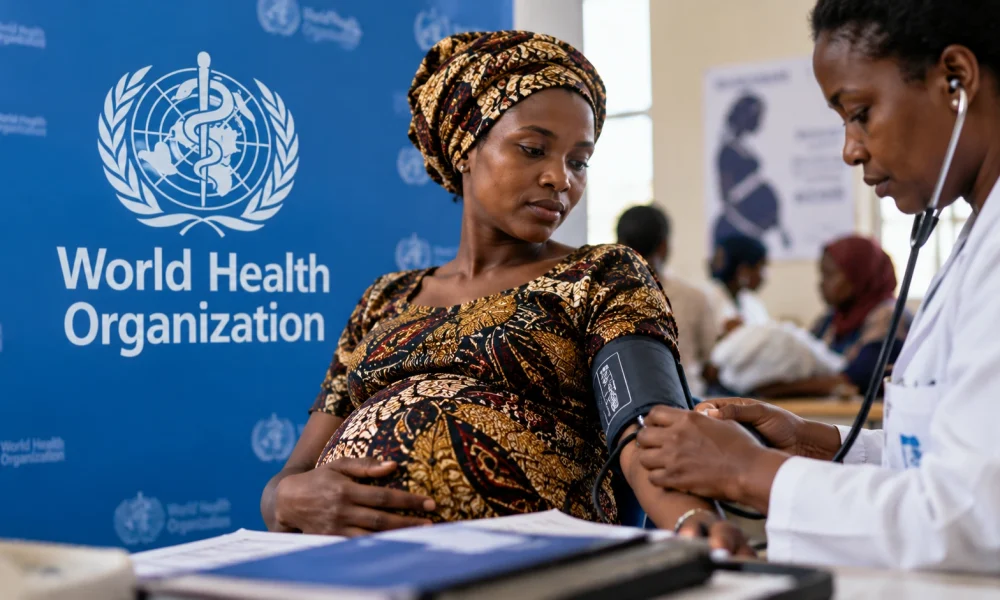
The World Health Organization has launched a new global strategy to prevent and treat hypertension during pregnancy, including pre-eclampsia.
The condition affects an estimated 10% to 15% of pregnancies worldwide and is responsible for around 16% of maternal deaths globally. WHO estimates that these conditions are associated each year with approximately 42,000 maternal deaths and more than 500,000 fetal and neonatal deaths.
Why pregnancy-related hypertension matters
Hypertension can develop during pregnancy even in women with no known previous health problems.
Pre-eclampsia can become severe and affect major organs, including the brain, kidneys and liver.
Without treatment, it can put both mother and baby at serious risk.
The problem is not only medical.
In many countries, women do not have reliable access to blood pressure monitoring, urine protein testing or essential medicines.
The difference between countries is enormous
One of WHO’s most important conclusions is that pregnancy outcomes can depend heavily on where a woman lives.
In well-funded healthcare systems, blood pressure can be checked regularly and symptoms investigated quickly.
In regions where there are too few doctors, inadequate hospitals or long distances to healthcare facilities, diagnosis can be delayed.
That can turn a treatable condition into a major health risk.
A lack of specialised treatments
WHO is also highlighting a lack of innovation.
While medical research has advanced rapidly in many areas, relatively few medicines have been developed specifically to prevent or treat pre-eclampsia and eclampsia.
A significant part of research has focused on diagnosis.
Fewer resources have gone toward developing new treatments.
Prevention remains essential
WHO stresses that basic interventions can save lives.
Regular blood pressure measurement is one of the most important.
Access to medicines such as aspirin, antihypertensive drugs and magnesium sulfate can also be critical in appropriate cases.
Referral systems must work quickly when complications develop.
The effects can continue after childbirth
Pregnancy-related hypertension is not always a condition that ends without consequences after delivery.
Women who have experienced these complications face higher long-term risks of chronic hypertension, cardiovascular disease, stroke and kidney disease.
Children exposed to severe pregnancy complications can also face increased risks later in life.
WHO wants a systemic change
The new roadmap covers the period from 2026 to 2035.
Its goal is to connect research, access to medicines, clinical guidelines, financing and government accountability.
That approach is important because the problem cannot be solved simply by developing a new medicine.
Functional healthcare services, trained staff and accessible diagnosis are also required.
A global problem, not just a medical one
Pregnancy-related hypertension illustrates one of the biggest challenges in global health.
Medical technology can advance rapidly, but outcomes depend on access.
A woman can benefit from modern treatments only if there is a healthcare system capable of detecting the problem in time.
For WHO, the new plan is an attempt to reduce that gap and make survival after pregnancy complications less dependent on the country in which a child is born.