Russia Stages Major Military Exercises With China and Other Partners as Regional Security Tensions Continue
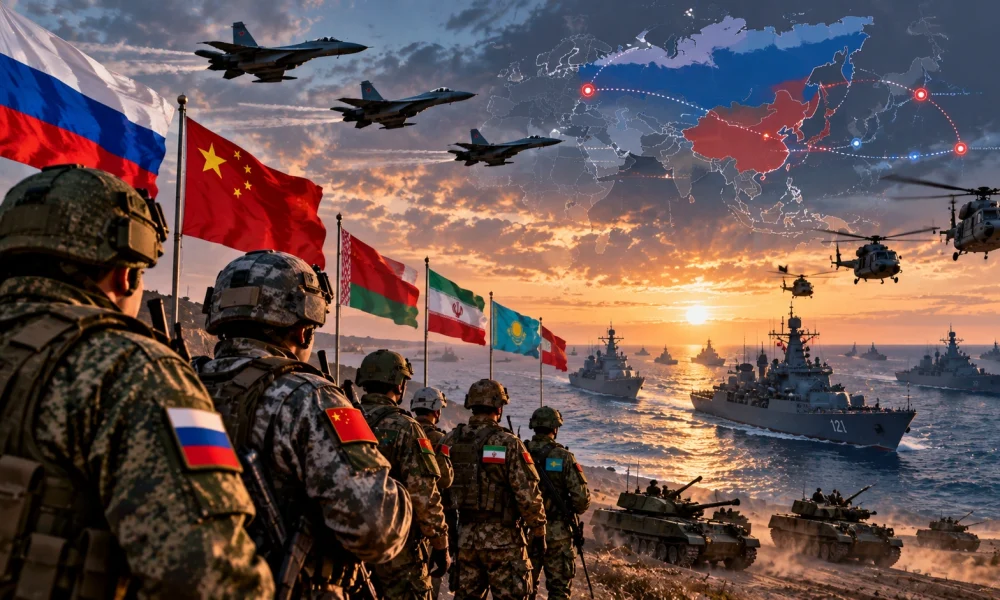
Russian President Vladimir Putin has observed the final phase of major military exercises involving tens of thousands of troops from Russia and several partner countries, highlighting the security relationships Moscow is maintaining outside the traditional Western alliance system.
The Center-2026 exercises involved around 47,000 troops during the week-long operation, according to The Associated Press. Military personnel and observers from countries including China, Belarus, Kyrgyzstan, Tajikistan, Mongolia and Pakistan were involved in various stages of the drills, while delegations from 55 countries observed the exercises.
The final phase took place in Russia’s Chelyabinsk region in the Urals, with additional activities conducted in the Caspian Sea.
A demonstration of military cooperation
The exercises are designed to test military coordination, command structures and the ability of participating forces to operate together.
China’s participation is particularly significant because Moscow and Beijing have developed closer strategic ties in recent years, even though their military relationship remains different from a formal mutual-defence alliance.
The presence of forces from several other countries also demonstrates Russia’s continued efforts to maintain defence and diplomatic relationships with governments outside the Western bloc.
The drills took place at a time of continued tension between Russia and NATO, with the war in Ukraine still shaping European security policy.
Advanced weapons on display
During the exercises, Putin inspected several weapons systems, including Russian drones.
The AP reported that Russian forces demonstrated jet-powered Geran drones, a type of weapon increasingly associated with Russia’s use of unmanned systems during the war in Ukraine.
The growing role of drones has transformed modern warfare, particularly in Ukraine, where both sides have relied heavily on relatively inexpensive unmanned systems for reconnaissance and attacks.
Russia’s military exercises therefore serve both an operational purpose and a signalling function, showing the capabilities Moscow wants potential partners and rivals to observe.
NATO remains a central reference point
The exercises also come amid renewed warnings from Russian officials about NATO.
Moscow has repeatedly criticised NATO’s expansion and Western military assistance to Ukraine. Western governments, meanwhile, argue that NATO’s strengthening is a response to Russia’s invasion of Ukraine and the resulting security concerns in Europe.
The competing narratives have become a central feature of European security politics.
For countries in Central and Eastern Europe, particularly those close to Russia and Belarus, military exercises of this scale are closely monitored.
Beyond the battlefield
The significance of Center-2026 extends beyond the number of troops involved.
Russia is attempting to demonstrate that it can maintain military cooperation with a broad group of countries despite Western sanctions and diplomatic pressure. China, meanwhile, continues to develop relations with Moscow while maintaining its own economic and diplomatic interests globally.
For NATO countries, the exercises provide another indication that Russia remains capable of organising large-scale military operations and maintaining partnerships outside Europe.
The immediate military significance of the drills will depend on how participating forces translate lessons from the exercises into future capabilities. Politically, however, the event reinforces the increasingly complex security environment in which Russia, China, NATO and other regional powers are adjusting their strategies.