Latvia Votes Under the Shadow of War as Security Becomes a Central Election Issue
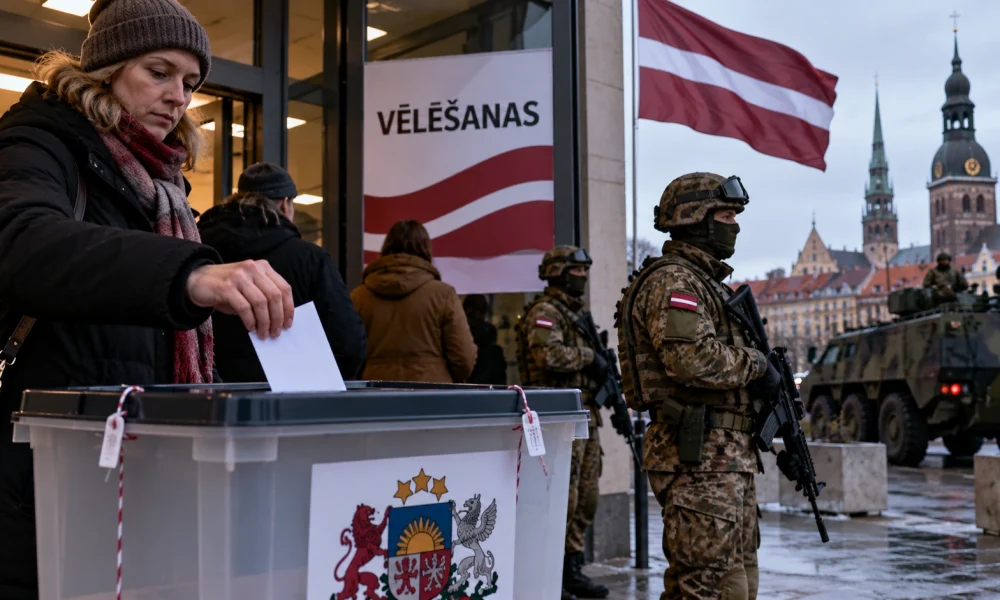
Latvia is holding parliamentary elections today in a political environment shaped heavily by the war in Ukraine, repeated airspace incidents and growing concerns about security along NATO’s eastern flank. Voters are choosing all 100 members of the Saeima for the next four-year term, with the result expected to determine the direction of the country’s security and foreign policy.
The election comes only months after Prime Minister Andris Kulbergs came to power following the collapse of the previous coalition. His government inherited a political debate increasingly dominated by security concerns after several military drones entered Latvian airspace.
According to Reuters, the drones were Ukrainian, although Latvian authorities have linked the incidents to the broader consequences of Russia’s war in Ukraine. The episodes have intensified discussions about Latvia’s ability to monitor and protect its airspace.
Security is at the centre of the campaign
Kulbergs has made support for Ukraine and the strengthening of Latvia’s defence capabilities central elements of his political platform. He has backed additional anti-drone systems and has pledged to maintain defence spending at around 5% of GDP, a level among the highest in NATO.
Other political forces have approached the issue differently. The pro-Russian Sovereign Power party has argued that Latvia should place greater emphasis on negotiations and domestic economic concerns rather than military assistance to Ukraine.
The debate reflects a broader tension inside Latvian society. The country of around 1.9 million people has a sizeable Russian-speaking population, while its geographical position between Estonia, Lithuania, Russia and Belarus gives security policy an unusually prominent role in domestic politics.
A fragmented parliament could complicate the next government
Polling before the election indicated that no party was close to securing a parliamentary majority. Reuters reported that Kulbergs’ United List was leading with around 14% support, followed closely by Sovereign Power, while Latvia First and the Progressives were also competing for parliamentary representation.
The figures underline the importance of coalition negotiations after the vote. Latvia’s political system has frequently required several parties to cooperate in order to form a government, meaning that the final distribution of seats may be more important than the performance of any single party.
For Kulbergs, maintaining a coalition could require negotiations with parties that have different positions on Ukraine, defence spending and relations with Russia.
The wider European dimension
Latvia’s election is being closely watched because its security debate mirrors concerns across the Baltic region. Estonia and Lithuania, like Latvia, are NATO and European Union members bordering or located close to Russia and Belarus.
Western officials have repeatedly said there is no evidence that Russia is preparing for a direct attack on NATO, while Moscow rejects accusations that it poses such a threat. Nevertheless, the war in Ukraine has led Baltic governments to increase defence spending and strengthen military preparedness.
The outcome in Riga will therefore have implications beyond domestic politics. It will also indicate how Latvian voters view the balance between national security, military spending, support for Ukraine and economic pressures at home.
What happens after the vote
The first results are expected shortly after polling stations close, but forming a government could take considerably longer if the new parliament remains fragmented.
The next government will face several immediate questions: how much Latvia should spend on defence, how strongly it should continue supporting Ukraine, how to improve protection against drones and how to address cost-of-living concerns without weakening its security commitments.
Latvia’s election is therefore taking place at a moment when foreign policy and domestic politics are increasingly difficult to separate.