AI Shopping Agents Split Retailers as the Next E-Commerce Battle Moves Beyond Search
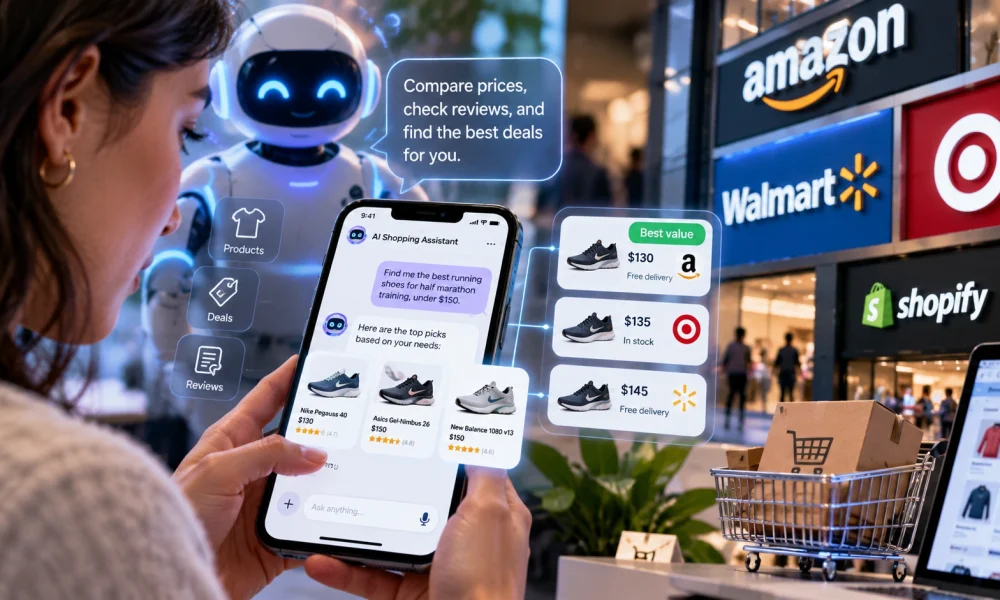
The next major change in e-commerce may not happen inside a marketplace or a shopping app. It may happen through artificial intelligence agents that search for products, compare offers and, with the customer’s permission, complete purchases.
The technology is already moving from experimentation into commercial deployment. Shopify has opened its checkout infrastructure to browser-based AI agents, while Google and Meta are developing their own systems for agent-led shopping. At the same time, major retailers are taking very different positions on whether these agents should be allowed to interact with their stores.
The result is an unusual split in the industry: some retailers are preparing their websites for a future in which AI agents become another sales channel, while others are actively blocking them.
Retailers are divided over control
Companies including Walmart, Gap and Best Buy have publicly embraced AI-driven shopping initiatives. QVC and HSN have gone further, making product catalogues available to AI developers and allowing shopping agents to complete purchases.
Other retailers are more cautious.
Amazon has blocked Meta’s Muse shopping agent, while Kohl’s is also restricting agentic purchasing. Tapestry, the parent company of Coach and Kate Spade, currently allows agents to browse but not complete purchases.
The disagreement is largely about control.
Retailers want to maintain control over customer data, pricing, product presentation and the shopping experience. They are also concerned about automated purchases, fraud, inventory manipulation and the possibility that AI systems could make large numbers of requests without the same commercial intent as human shoppers.
Shopify is taking the opposite approach
Shopify has moved aggressively toward an open model.
The company recently enabled browser-based AI agents to complete purchases on Shopify-powered websites. Its WebMCP infrastructure allows agents to search products, add items to carts and interact with checkout systems, including Shop Pay, with the customer’s authorization.
This could significantly change the role of an online store.
Instead of a consumer visiting a website, navigating categories and comparing products manually, an AI assistant could potentially handle most of the process.
For merchants, that means the website needs to be understandable not only to people but also to software agents.
Product data becomes a competitive asset
Traditional e-commerce optimisation focused heavily on search rankings, advertising and conversion rates.
Agentic commerce introduces another layer.
AI systems need accurate information about product specifications, availability, pricing, delivery times, reviews and returns.
A retailer with incomplete or inconsistent product data could therefore become less visible to AI shopping assistants.
This could make product information management as strategically important as traditional search engine optimisation.
Consumers remain cautious
Technology companies are promoting agentic commerce as a way to reduce the time consumers spend searching and comparing products.
But widespread consumer adoption has not yet been established.
Many people remain reluctant to give an AI system permission to make purchases using their payment information.
The issue becomes even more sensitive when purchases involve expensive products, personal preferences or services that require human judgment.
A new e-commerce gateway
The development nevertheless represents a fundamental change.
Search engines once became the gateway between consumers and online stores. Marketplaces later became another major gateway.
AI assistants could become the next one.
If consumers begin asking AI systems to handle routine shopping, retailers will need to compete not only for human attention but also for visibility inside algorithms that decide which products are presented.
The e-commerce industry is therefore entering a new phase in which the most important interface may no longer be a website or an app, but an intelligent intermediary acting on behalf of the customer.