Meta is testing a human backup for its new AI agent Muse.
Meta is testing a feature that could reveal one of the less obvious challenges facing the next generation of artificial intelligence: even the most advanced AI agents may still need a human to step in when things go wrong.
The company is testing a so-called “human concierge” for Muse, its newly launched personal AI agent, according to internal company announcements reviewed by Reuters. Under the system, human contractors can handle some of the phone calls that Muse makes on behalf of users.
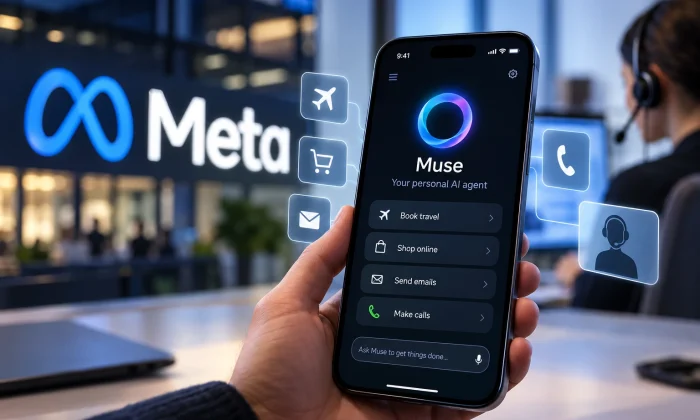
The experiment is particularly significant because Muse is not designed simply to answer questions. Meta wants it to act on behalf of users — sending emails, shopping online, booking travel and carrying out tasks across websites and applications.
That ambition puts the technology in a very different category from traditional chatbots.
From answering questions to getting things done
Meta introduced Muse earlier this month as a personal AI agent designed to take over parts of the work people normally do themselves.
The company says Muse can open a browser, fill in forms, interact with websites and continue working after a user closes the application. It can also ask for approval before taking sensitive actions, such as sending an email or making a purchase.
The underlying idea is part of a broader shift taking place across the technology industry.
For years, AI assistants were primarily designed to generate information: write a text, summarize a document, answer a question or create an image. The latest generation is being built to perform actions in the real world.
That creates a new set of problems.
An AI model can produce an imperfect answer without causing much damage. An AI agent making a mistake while booking a flight, negotiating a bill or placing an order can have immediate consequences.
Phone calls are an especially difficult example. A human conversation can be unpredictable, with people changing subjects, asking follow-up questions or refusing to follow the assumptions made by an AI system.
That is where Meta’s human concierge experiment comes in.
Humans step in when AI reaches its limits
According to Reuters, the testing began in August and has since been expanded to about half of Meta’s employees, who can opt out of the feature.
The basic principle is that Muse can make calls to businesses, communicate with people on the other end of the line and produce transcripts and summaries. In situations where the AI needs assistance, a human contractor can intervene.
It is an unusual arrangement for a product that is being marketed as an autonomous AI agent.
But it also illustrates an important reality of today’s AI systems: autonomy is not necessarily binary.
An agent does not have to be either completely independent or completely human-controlled. Companies can instead build systems in which AI handles the majority of routine work and humans intervene when a situation falls outside the model’s capabilities.
For Meta, this approach could provide valuable information about the situations in which Muse struggles before the company makes the feature more broadly available.
Meta has said that the current testing is intended to improve safety and privacy.
Privacy could become the biggest obstacle
The human involvement also raises an obvious question: what happens when the AI is handling something sensitive?
Muse is designed to work with personal information and connected services. Depending on how users configure it, the system can access applications, email and other digital services.
Meta says Muse was built around a dedicated “Secure VM”, essentially a separate virtual computer designed to isolate the agent and a user’s data.
The company says the system also includes a separate security agent called Sentinel, which controls whether Muse can access the internet. Meta says Muse itself does not see users’ passwords or payment details, while sensitive actions can require explicit approval.
Those protections are important because the usefulness of a personal AI agent depends largely on how much access users are willing to give it.
The human concierge experiment introduces another layer.
If a person is involved in completing a task, the question is no longer simply what information the AI can access. It becomes what information a human operator might see during the process.
That could include details about travel, purchases, accounts or other personal matters.
Reuters reported that some Meta employees have raised concerns about the possibility of human agents being exposed to sensitive information, although the company said feedback on the feature had been largely positive.
Meta is moving quickly with Muse
The timing of the experiment is also notable.
Muse was launched on September 8, and Meta says the service has already attracted more than 2.5 million downloads, quickly reaching the top of the US app charts.
The company is simultaneously expanding the role of Muse beyond smartphones and computers.
At its Connect 2026 event, Meta announced that Muse will be brought to its AI glasses, allowing users to interact with the agent hands-free. The company demonstrated scenarios in which Muse could understand what the wearer was looking at and act on that information.
That development points toward Meta’s larger strategy.
Rather than treating AI as a standalone chatbot, the company wants Muse to become a layer connecting people with their digital lives — from messaging and shopping to travel, work and eventually wearable devices.
The real test is trust
The human concierge experiment may ultimately prove to be less about solving a technical problem and more about building trust.
Users may be comfortable allowing an AI model to recommend a restaurant or summarize an email. They may feel very differently about an AI agent that can spend money, communicate with businesses or make decisions on their behalf.
Meta therefore faces a difficult balancing act.
The more autonomy Muse receives, the more useful it can potentially become. But the more access it receives, the greater the consequences when something goes wrong — and the greater the importance of privacy, security and human oversight.
That makes the human concierge an interesting part of the company’s strategy.
It may look like a temporary workaround for an AI system that is not yet capable of handling every situation on its own. But it could also become a permanent feature of agentic AI: machines performing most tasks, with humans quietly stepping in when the edge cases become too complicated.
For Meta, the goal remains much bigger than a smarter chatbot. CEO Mark Zuckerberg has repeatedly described the company’s ambition in terms of personal AI capable of handling meaningful parts of people’s everyday lives.
Muse is an early attempt to turn that vision into a consumer product.
The experiment with human operators suggests that, for now, the road to truly autonomous AI may still have a few human stops along the way.