Kingfisher raises outlook as European home improvement demand shows signs of resilience.
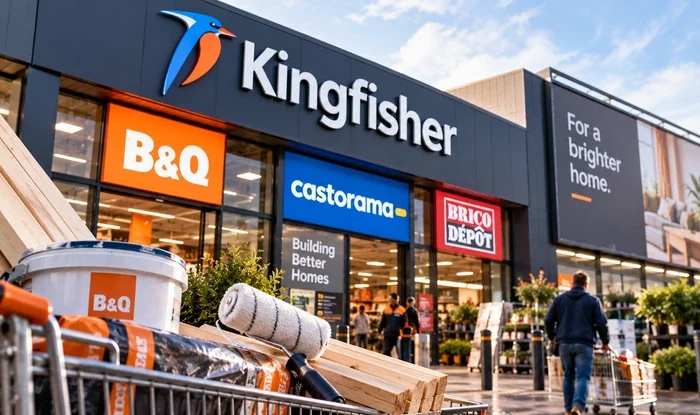
Europe’s home improvement market is showing early signs of resilience after a difficult period for consumers, with Kingfisher raising its annual profit outlook as demand improves in several key markets.
The group, which owns B&Q and Screwfix in the UK and Ireland, as well as Castorama and Brico Dépôt in France and other European markets, reported stronger than expected first-half results on September 22. The improvement was supported by market share gains in the UK, Poland and Spain, strong trade activity and continued growth in e-commerce.
Kingfisher now expects adjusted profit before tax for the financial year ending in January 2027 to reach between £595 million and £635 million. Its previous forecast was between £565 million and £625 million.
The upgrade is significant because it comes at a time when household spending remains cautious and consumers across Europe continue to face pressure from living costs, borrowing costs and uncertainty around the wider economy.
A mixed recovery rather than a consumer boom
Kingfisher’s latest numbers do not point to a broad-based surge in home improvement spending. Instead, they suggest that consumers are becoming more selective about where they spend money and which projects they are prepared to undertake.
Group sales, including marketplace sales, increased 1.6% to £7.1 billion in the six months to July 31. Underlying like-for-like sales rose 0.3%, while adjusted profit before tax increased 9.9% to £404 million.
The difference between sales growth and profit growth is important. Kingfisher benefited from a 70 basis point improvement in gross margin, tighter cost control and a £14 million business rates refund.
In other words, the improved outlook is not based solely on consumers spending substantially more on their homes. Operational improvements and a stronger mix of business are also playing an important role.
That distinction matters for the wider Home&Deco market because household demand remains uneven.
Screwfix is driving much of the momentum
One of the strongest performances came from Screwfix, Kingfisher’s trade-focused business.
Like-for-like sales at Screwfix increased 5.6% during the first half. The business benefited from demand from professional customers, e-commerce growth, product innovation and seasonal categories.
Screwfix has become increasingly important to Kingfisher because professional customers tend to shop more frequently than ordinary consumers and can provide a more predictable source of demand.
The group said trade sales excluding Screwfix increased 16%, taking trade activity to 31% of total group sales, three percentage points higher than a year earlier.
That shift reflects a broader trend in the home improvement industry. When consumers are reluctant to commit to expensive renovation projects, professional activity can provide an important counterbalance, particularly when repair, maintenance and smaller construction projects remain active.
Kingfisher has been investing heavily in this segment through specialist ranges, dedicated services, loyalty programmes and improvements to its online and in-store experience.
Kitchens are performing better than bathrooms
The latest results also reveal how differently individual Home&Deco categories are behaving.
Kitchens have performed relatively well, particularly in the UK and Poland. Kingfisher attributed some of the improvement to new product ranges and greater investment in selling capabilities.
Bathrooms, however, have remained under pressure.
The contrast illustrates the difficulty facing retailers in the current market. Consumers may still be willing to invest in certain areas of their homes, but larger discretionary projects can be delayed when household budgets are tight.
Bathrooms, kitchens and other renovation categories often involve significantly higher spending than basic DIY products. A consumer who is willing to buy paint, tools or garden equipment may still postpone a complete bathroom renovation.
Kingfisher has responded by reviewing its bathroom range and introducing new products, including the Imandra 2 bathroom furniture range, alongside refreshed sinks and taps.
The company said it had seen encouraging early results from some of these changes.
Heatwaves change what consumers buy
Weather has also played a surprisingly important role in the latest figures.
A series of heatwaves across Europe boosted demand for air conditioning, cooling products and garden leisure equipment. Kingfisher also benefited from increased interest in outdoor living, including products such as pergolas.
At the same time, extreme heat negatively affected some categories.
Plant sales, outdoor paint and fencing were among the areas affected, while changes in consumer behaviour also pushed some customers away from physical stores and toward online shopping.
This highlights an increasingly important factor for Home&Deco retailers. Seasonal demand is becoming more difficult to predict, particularly as unusual weather patterns influence when and how consumers use their outdoor spaces.
For large retailers, the ability to move inventory and adjust promotions quickly can therefore have a direct impact on profitability.
Online shopping continues to gain ground
The latest figures also reinforce the structural shift toward digital shopping in home improvement.
Kingfisher’s e-commerce sales excluding Screwfix increased 16% during the first half. Group e-commerce penetration reached 22%, up two percentage points from the previous year.
The company has also been expanding its marketplace business. Marketplace gross merchandise value increased 42% to £372 million, generating a profit contribution of £13.4 million, compared with £7 million in the same period a year earlier.
This is more than a change in where customers make purchases. Home improvement is particularly suited to digital tools that help shoppers compare products, understand specifications and identify the materials needed for a project.
Kingfisher has been investing in artificial intelligence for precisely this reason.
Earlier this year, the group announced a partnership with Google Cloud to introduce AI-powered shopping tools across the online platforms of B&Q, Castorama and Brico Dépôt. The objective is to move beyond traditional keyword searches and make product discovery more conversational.
For customers planning a renovation project, that could eventually mean describing what they want to build or repair in natural language and receiving recommendations for the products, quantities and tools required.
The European picture remains uneven
Kingfisher operates across seven countries, meaning its results provide a useful snapshot of different consumer environments across Europe.
Poland and Spain were among the markets where the group gained market share, while Screwfix delivered strong growth in the UK and other international markets.
The picture in France was more difficult. Consumer demand remained subdued, particularly for larger discretionary purchases, and Brico Dépôt France was affected by the impact of heatwaves on its product mix.
B&Q also faced weaker demand in the UK. Like-for-like sales at B&Q fell 2.9% during the first half, with softer demand in bathrooms and other big-ticket categories.
This makes Kingfisher’s upgraded forecast more nuanced than a simple recovery story.
The company is gaining from areas where consumers and professionals continue to spend, while some of the most expensive home improvement projects remain constrained.
What it means for the Home&Deco market
Kingfisher’s results suggest that the European home improvement market may be entering a more stable phase, but the recovery is likely to be gradual and uneven.
Consumers are still looking for value and are often choosing to improve their existing homes rather than move or undertake major property-related spending. Smaller renovation projects, maintenance work, outdoor living and energy-related improvements can therefore remain relatively resilient even when large discretionary purchases slow.
For retailers, this creates an incentive to offer products across different price points while improving digital services and building stronger relationships with professional customers.
Technology is becoming part of that strategy as well. AI-powered search, marketplaces and personalised recommendations are increasingly being used to make the home improvement shopping experience easier and more efficient.
Kingfisher’s upgraded forecast reflects confidence in this combination of factors. But the company is still operating in an environment where consumers remain cautious.
The latest numbers therefore point less to a dramatic return of the European DIY boom and more to a market learning how to grow under tighter household budgets.
For the Home&Deco sector, that could prove to be the defining trend of the next stage of the recovery: consumers are still spending on their homes, but they are choosing more carefully where the money goes.
Sources: Kingfisher, Reuters, RTE, company half-year results