Houthis Strike Yemen Presidential Palace in Aden, Killing Two as Regional Conflict Escalates
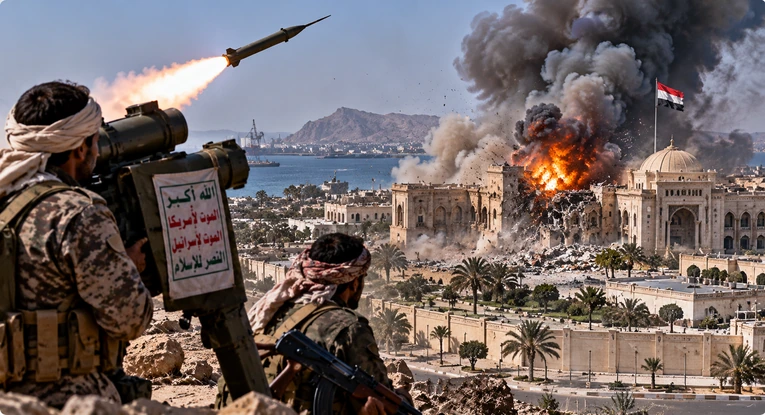
Yemen’s Houthi rebels launched a missile attack on the presidential palace complex in the southern port city of Aden on Thursday, killing two security guards and injuring at least six people, according to Yemeni officials cited by Reuters and the Associated Press. The strike marks a significant escalation in the conflict between the Iran-aligned movement and forces supporting Yemen’s internationally recognised government.
The attack targeted the al-Maashiq palace complex, which serves as a key government headquarters. Yemeni Information Minister Moammar al-Eryani said Prime Minister and cabinet members present at the complex were safe following the incident.
The Houthis claimed responsibility, saying they had targeted a military operations headquarters associated with Saudi forces. Their account of the intended target has not been independently verified. The attack came amid renewed fighting in Yemen and a broader regional confrontation involving Iran and its rivals.
A direct strike on a government stronghold
Witnesses reported multiple explosions in the vicinity of the palace, prompting panic among residents and security concerns across Aden. Officials said the attack involved missiles, while the government also reported the use of drones.
The al-Maashiq complex is an important centre of authority for Yemen’s internationally recognised government, which is backed by Saudi Arabia. Although much of the country remains divided between rival forces, Aden has served as a principal base for government institutions and officials.
The strike is particularly significant because it brought the conflict directly to a prominent government site in a city that has remained outside Houthi control. The deaths of two security guards underline the human cost of the escalation, while the reported injuries raise further concerns about the risks facing personnel and civilians near strategic installations.
In its statement, the Houthi military leadership described the operation as part of a campaign against Saudi military deployments in Yemen. The group has increasingly framed its actions as an effort to pressure Riyadh over its role in the conflict.
Saudi Arabia and its partners have accused the Houthis of expanding attacks against strategic infrastructure. However, claims made by the opposing sides regarding targets, weapons and responsibility for individual incidents require independent verification.
Conflict spreads pressure beyond Yemen
The attack in Aden comes as fighting intensifies around Taiz, Yemen’s third-largest city, where government-aligned forces and Houthi fighters have been engaged in renewed clashes. The fighting has raised concerns about access to essential goods and the ability of humanitarian organisations to reach vulnerable communities.
The wider conflict also carries implications for regional security. Yemen sits near the Bab el-Mandeb Strait, a strategic maritime passage connecting the Red Sea with the Gulf of Aden and the Indian Ocean. The waterway is an important route for international shipping, including energy supplies and commercial goods moving between Europe and Asia.
Any sustained escalation around the strait could increase shipping risks, raise insurance costs and complicate decisions by commercial operators. The consequences would extend beyond Yemen, particularly if attacks begin to affect maritime traffic or other critical infrastructure more directly.
The conflict has also placed Saudi Arabia under growing pressure. The Saudi-led coalition has reported intercepting missiles and drones in Saudi territory, including near strategically important locations. The coalition has accused the Houthis of pursuing a wider campaign against Saudi infrastructure, while the Houthis have continued to present their operations as retaliation for Saudi involvement in Yemen.
These developments increase the risk that the conflict could become more closely linked to the wider confrontation involving Iran and regional powers. They do not, however, establish that every attack in the region is coordinated or directed by a single actor.
Humanitarian concerns deepen as fighting resumes
For Yemen’s population, renewed hostilities threaten to worsen an already severe humanitarian crisis. Years of conflict have damaged infrastructure, weakened public services and left many communities dependent on humanitarian assistance.
The situation in Taiz is especially concerning. The Associated Press reported that access to essential supplies has deteriorated, with residents facing shortages of food, fuel and other necessities. The World Food Program has warned that hundreds of thousands of people in the area are beyond its current reach for aid deliveries.
Further disruption could increase prices, limit access to healthcare and make it harder for displaced families to obtain basic necessities. Civilians living near front lines or strategic installations face additional risks as fighting expands.
Humanitarian organisations have repeatedly stressed the importance of protecting civilians and ensuring safe, sustained access to people in need. Any prolonged escalation would make those objectives more difficult to achieve.
What happens next?
The immediate priority is to establish the full extent of the damage, support the injured and determine whether further attacks are imminent. Regional governments will also be watching for signs of retaliation and any additional threats to airports, energy infrastructure or maritime routes.
Diplomatically, the attack adds another obstacle to efforts to contain the conflict. Saudi Arabia and its partners face pressure to respond to attacks on their personnel and infrastructure, while the Houthis have signalled that they intend to continue targeting what they describe as Saudi military assets.
A wider escalation is not inevitable, but the combination of renewed ground fighting, strikes against government-linked facilities and threats to regional infrastructure raises the stakes for all parties involved.
For now, the confirmed facts are that the palace complex in Aden was struck, two security guards were killed and at least six people were injured. The Houthis claimed responsibility, while their stated explanation for the target remains unverified. Further developments will determine whether Thursday’s attack remains an isolated escalation or becomes part of a broader intensification of the regional conflict.