Global Life Expectancy Returns Near Pre-Pandemic Levels, but Healthy Years Lag Behind
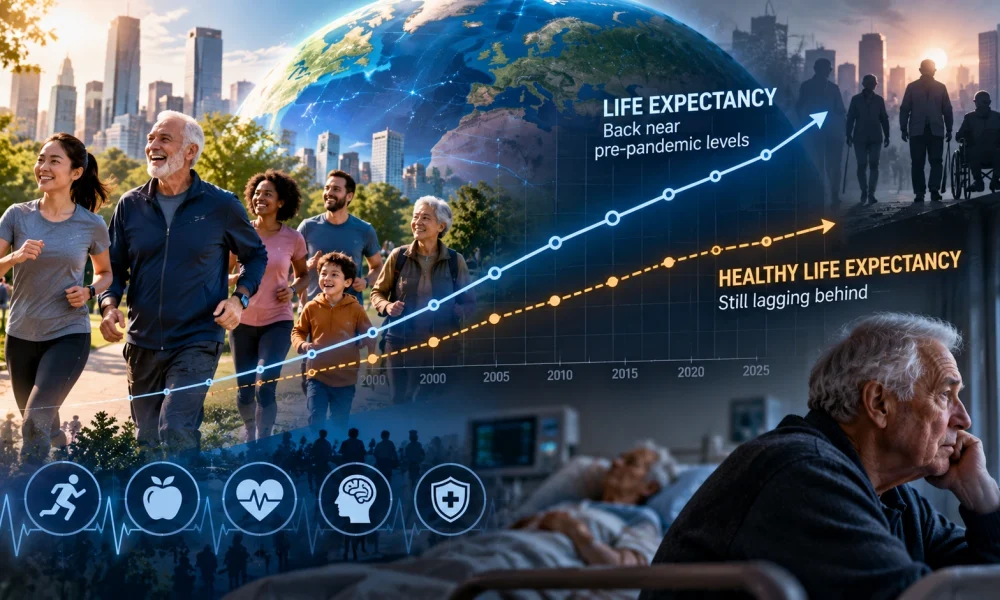
Global life expectancy has almost recovered to its pre-pandemic level, according to new estimates from the World Health Organization, but the number of years people can expect to live in good health has recovered more slowly.
The WHO’s latest Global Health Estimates show that average global life expectancy reached 73.3 years in 2023, compared with 73.4 years in 2019, before the COVID-19 pandemic disrupted health systems and increased mortality worldwide. (who.int)
The figures provide one of the clearest indications yet that the global demographic impact of the pandemic is beginning to recede.
The recovery is not complete
Although overall life expectancy has nearly returned to its previous level, healthy life expectancy remains below its 2019 figure.
In 2023, people could expect to live an average of 62.8 years in good health, 0.4 years below the 2019 level.
The difference highlights an important distinction between living longer and living longer without significant illness or disability.
For health systems, the second measure can be more difficult to address because it depends on chronic disease, disability, access to treatment and the quality of long-term care.
Chronic diseases dominate the global picture
The WHO estimates that noncommunicable diseases accounted for 74% of deaths worldwide in 2023, compared with 58% in 2000.
Eight of the world’s ten leading causes of death were noncommunicable diseases.
Cardiovascular disease remains the largest contributor to global mortality.
Ischaemic heart disease alone caused approximately 9.5 million deaths in 2023 and was responsible for around 210 million disability-adjusted life years, a measure combining premature death and years lived with disability. (who.int)
Dementia is becoming a larger global burden
The WHO data also shows a significant increase in the global impact of dementia.
Dementia became the fifth leading cause of death worldwide in 2023, compared with 19th place in 2000.
Deaths attributed to dementia tripled over that period.
The change is partly connected to population ageing, as dementia becomes more common as people live longer.
It also creates increasing pressure on families, healthcare systems and long-term care services.
Mental health remains a major concern
The global health burden associated with mental health conditions has also changed significantly.
Between 2019 and 2023, the global age-standardised disease burden associated with depressive disorders increased by approximately 20%, while the burden linked to anxiety disorders rose by almost 45%.
Together, the two conditions accounted for an estimated 110 million years of healthy life lost in 2023.
The figures indicate that the health consequences of the pandemic extend beyond direct infections and mortality.
A changing challenge for lower-income countries
The WHO estimates also reveal an important shift in poorer countries.
For the first time, communicable diseases accounted for less than half of all deaths in low-income countries in 2023.
That represents another stage in the global epidemiological transition, as infectious diseases become relatively less dominant while chronic conditions become more important.
However, the transition does not mean infectious diseases have disappeared.
Many lower-income countries continue to face simultaneous pressures from infectious diseases, maternal and child health challenges and increasing rates of chronic illness.
Living longer creates a new health policy challenge
The recovery in global life expectancy is an important public health achievement.
But it also creates a new question for governments and healthcare systems.
As populations live longer, countries need to provide more long-term care, chronic disease management and services designed to maintain independence among older adults.
The WHO estimates show that the next phase of global health will not simply be about extending life.
It will increasingly be about reducing the years people spend living with preventable illness and disability.