ESA’s Juice Mission Uses Earth Flyby to Continue Its Journey Toward Jupiter
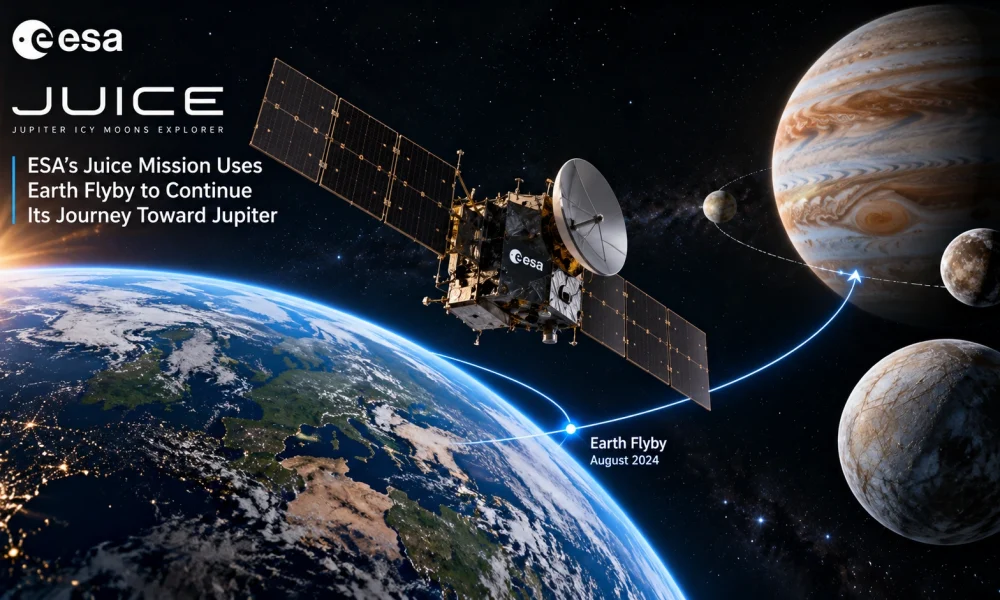
The European Space Agency’s Juice spacecraft has successfully used Earth’s gravity to alter its trajectory as it continues its long journey toward Jupiter.
The spacecraft passed Earth on September 28, using a carefully calculated gravitational manoeuvre to gain speed and change direction.
A gravity assist in deep space
Spacecraft travelling to distant planets cannot simply accelerate continuously with their own engines.
Carrying enough fuel for such a journey would make missions far heavier and more expensive.
Instead, engineers can use the gravity of planets to change a spacecraft’s trajectory.
The technique is known as a gravity assist.
Juice has a demanding mission
Juice is designed to study Jupiter and several of its icy moons.
The spacecraft will focus particularly on Ganymede, the largest moon in the Solar System.
Scientists are interested in Ganymede because evidence suggests that a large ocean may exist beneath its icy surface.
Why icy moons matter
Jupiter’s moons are among the most interesting locations in the Solar System for scientists searching for environments that could potentially support life.
Europa is also believed to contain a subsurface ocean, while Callisto has shown evidence of a complex internal structure.
Juice will provide detailed observations of the Jupiter system that could help scientists better understand how these worlds formed and evolved.
Years of preparation
The Earth flyby demonstrates the precision required for modern space exploration.
A small change in speed or direction can significantly alter a spacecraft’s position after travelling millions of kilometres.
The mission therefore depends on calculations performed years before the spacecraft reaches its final destination.
The road to Jupiter
Juice still has a long journey ahead.
Its eventual arrival will mark the beginning of a major scientific campaign around Jupiter and its moons.
The mission could provide some of the most detailed observations ever made of an icy moon outside Earth’s immediate neighbourhood.