Bentley unveils its first fully electric model and bets on luxury without a combustion engine.
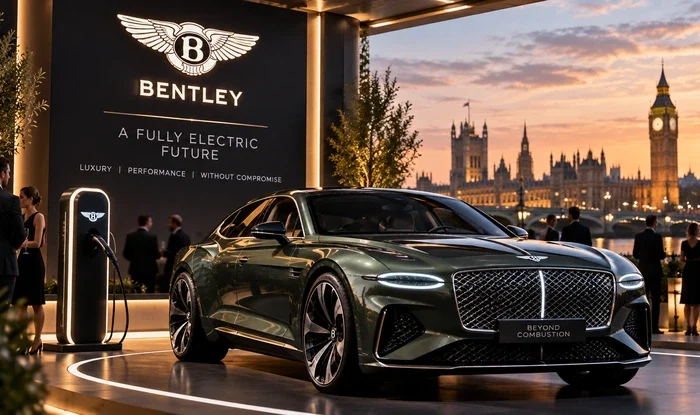
Bentley has entered the electric era with the launch of the Torcal, the British luxury carmaker’s first fully electric production model and one of the most important new vehicles in its recent history.
Unveiled in London on September 23, the Torcal represents a major change for a brand whose identity has been built for more than a century around large petrol engines, exceptional craftsmanship and effortless performance. But Bentley is taking a deliberately cautious approach to electrification.
Rather than creating a radically different electric car, the company has designed the Torcal to remain recognisably Bentley. The model retains familiar design elements, a handcrafted interior and a strong emphasis on comfort, while replacing the combustion engine with a high-performance electric powertrain.
The message from Bentley is clear: electric technology should change how the car moves, but not necessarily how a Bentley feels.
An electric Bentley that still looks like a Bentley
The Torcal is a large luxury SUV and becomes the fourth model line in Bentley’s current range, joining the Bentayga, Continental GT and Flying Spur.
Its design deliberately connects the new electric model with the company’s existing cars.
One of the most visible examples is the front end. Electric vehicles do not require the large traditional grille used to provide airflow to a combustion engine, but Bentley has created a new interpretation of its familiar design language.
The Torcal uses a floating diamond grille containing 76 individually applied LED elements. The lights are intended to provide a visual connection with the brand’s traditional front grille while giving the electric model its own identity.
The approach reflects a broader challenge facing luxury manufacturers. Customers who spend hundreds of thousands of pounds on a vehicle are often buying more than transportation. They are buying design, craftsmanship, heritage and a sense of continuity.
Bentley therefore believes that its first EV needs to feel like a Bentley before it needs to feel like a completely new type of car.
Performance is not being sacrificed
The Torcal arrives with serious performance credentials.
The standard model produces up to 821 PS and 1,194 Nm of torque, while the more powerful Torcal S reaches 888 PS and 1,350 Nm when launch control is activated.
That makes the Torcal S the most powerful production Bentley ever built.
The standard version can accelerate from zero to 100 km/h in around 3.4 seconds, while the Torcal S can complete the same sprint in approximately 2.9 seconds.
Top speed is 250 km/h for the standard model and 260 km/h for the S.
Those figures place the Torcal firmly within the performance luxury segment. But Bentley’s engineers are not positioning outright acceleration as the main reason to buy the car.
The company’s traditional priorities remain comfort, refinement and effortless power.
That distinction is important. Electric motors naturally provide instant torque and smooth acceleration, making them particularly suitable for luxury vehicles. The absence of gear changes and engine vibration can also create a quieter and more relaxed driving experience.
For Bentley, electrification can therefore reinforce some of the characteristics that customers already associate with the brand.
Up to 600 kilometres of range
The Torcal uses an 800 volt electrical architecture and a 113 kWh battery.
Bentley says the model can achieve a range of up to approximately 600 kilometres, depending on version and testing conditions.
The charging system supports up to 400 kW, allowing the battery to be charged from 10% to 80% in around 16 minutes under suitable conditions.
That capability is becoming increasingly important in the luxury EV market.
For customers accustomed to long-distance travel, range anxiety can be a significant barrier to switching from petrol to electric. Bentley is therefore trying to remove one of the biggest practical objections to high-end electric vehicles by combining a large battery with rapid charging.
The technology also comes from within the wider Volkswagen Group ecosystem. The Torcal is based on the group’s Premium Platform Electric architecture, which is also used by other high-performance electric models within the group.
Bentley’s differentiation comes from how that technology is integrated into the vehicle rather than from developing every component independently.
The sound of a Bentley without a V8
Perhaps the most unusual part of the Torcal experience is what drivers hear.
An electric vehicle does not produce the mechanical sound associated with Bentley’s large combustion engines. Instead of simply accepting that silence, Bentley has developed a new driving soundtrack using real musical instruments.
The company says the Bentley Dynamic Symphony is inspired by the character and rhythm of its historic 6.75 litre V8.
The soundtrack incorporates instruments including drums and is designed to respond to acceleration and vehicle speed.
It is an interesting compromise between tradition and technology.
For some customers, the disappearance of the combustion engine’s sound may be part of the appeal of an EV. For others, engine noise is an important part of the emotional connection with a luxury performance car.
Bentley’s solution attempts to preserve some of that emotional experience without pretending that the electric car has a conventional engine.
A major investment in Crewe
The Torcal is also important for Bentley’s home factory in Crewe, England.
The company has invested around £350 million in its UK operations to prepare the site for the electric model. A new production line has been created within one of the historic buildings at the factory, allowing Bentley to manufacture the Torcal alongside its existing vehicles.
The investment supports around 4,000 jobs at the Crewe site and represents a significant commitment to keeping production in Britain.
For Bentley, this is more than an investment in one model. It is an attempt to transform an established manufacturing operation for a different era of automotive technology.
Electric vehicles require different production processes, battery handling capabilities, software integration and high-voltage safety procedures.
At the same time, Bentley is trying to maintain the hand-built character that has traditionally differentiated its products from mass-market vehicles.
The Torcal therefore becomes a test of whether an ultra-luxury manufacturer can introduce high-volume modern technology without losing the craftsmanship associated with its brand.
Bentley has changed its electrification timetable
The launch comes after Bentley significantly revised its original electrification plans.
The company had previously targeted an all-electric model range by 2030. But weaker than expected demand for luxury electric vehicles, changes in regulations and uncertainty over charging infrastructure have encouraged Bentley to adopt a more flexible strategy.
The company has now moved away from setting a fixed deadline for ending combustion-engine production.
That does not mean Bentley is abandoning electrification. The Torcal is evidence that electric vehicles remain an important part of the company’s future.
Instead, Bentley intends to offer a combination of electric, plug-in hybrid and combustion-engine vehicles for the foreseeable future, allowing its product strategy to respond to customer demand.
This approach mirrors a broader shift taking place across the premium automotive industry.
Several luxury manufacturers that previously announced aggressive electric-only targets have become more cautious as EV adoption has developed more slowly in some high-end markets than initially expected.
The luxury EV market is changing
Bentley’s challenge is particularly interesting because the luxury segment operates differently from the mass market.
A buyer spending £173,000 or more on a vehicle is not necessarily choosing it because it is the cheapest or most efficient option.
The decision can be driven by design, status, performance, craftsmanship, exclusivity and brand heritage.
That makes the transition to electric propulsion both an opportunity and a risk.
Electric technology offers characteristics that suit luxury vehicles extremely well: smooth acceleration, low cabin noise, instant torque and sophisticated software.
But luxury customers can also be particularly attached to the traditional experience associated with premium cars.
Bentley is therefore attempting to bridge both worlds.
The Torcal is electric, but it does not try to hide its heritage. It has the familiar Bentley proportions, premium materials, handcrafted details and a driving experience designed around comfort rather than simply chasing performance numbers.
A more accessible Bentley
Another important aspect of the Torcal is its positioning within the Bentley range.
With a starting price of around £173,000 in the UK, it sits toward the lower end of the company’s current pricing structure.
Bentley executives have described the model as a more accessible entry point to the brand, potentially opening the door to new customers.
That could become increasingly important as younger wealthy consumers develop different expectations around technology, sustainability and digital connectivity.
The Torcal gives Bentley an opportunity to attract customers who may not have considered a traditional large-engine Bentley, while also giving existing customers the option to move into an electric model without leaving the brand.
Bentley’s electric future starts with a compromise
The Torcal does not represent a complete break with Bentley’s past.
In many ways, that is precisely the point.
The company is betting that wealthy customers do not necessarily want a luxury EV that feels completely different. They want an electric vehicle that still provides the qualities they associate with the brand.
That means exceptional materials, comfort, performance, exclusivity and attention to detail, combined with the advantages of electric propulsion.
The Torcal is therefore more than Bentley’s first battery-powered car. It is a test of whether a century-old luxury identity can survive a fundamental change in automotive technology.
Bentley is not promising that the combustion engine will disappear overnight. Instead, it is giving customers another way to experience the brand while gradually preparing its manufacturing operations and product range for an increasingly electric market.
The success of the Torcal will ultimately depend on whether customers believe that an electric Bentley can deliver the same emotional value as one powered by a traditional engine.
For a company whose reputation was built around the sound, feel and character of those engines, that may be the most important test of all.
Sources: Bentley Motors, Reuters, Euronews, The Guardian