Greggs Plans Major Expansion While Reshaping the Supply Chain Behind Its Growth
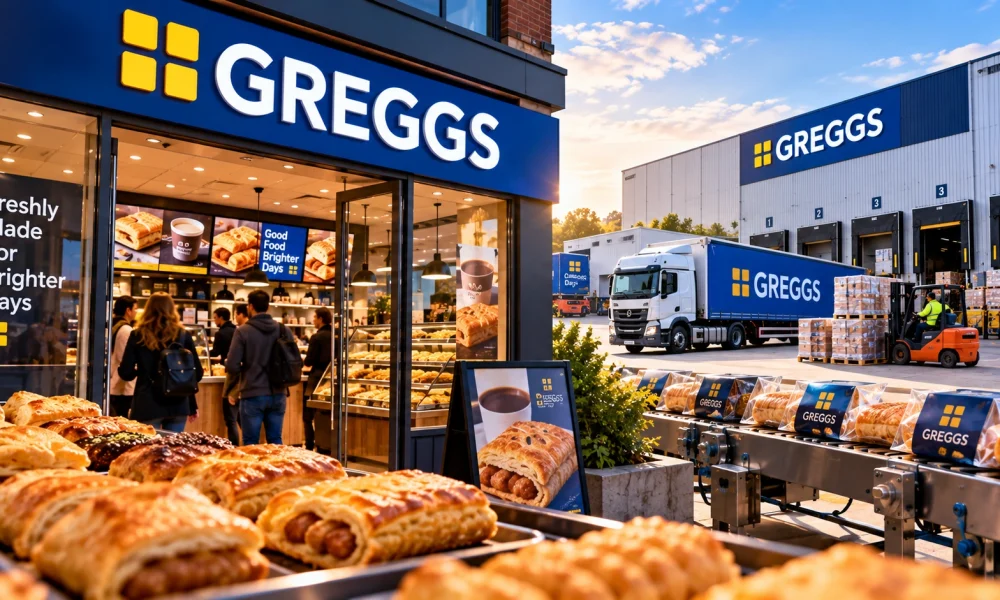
British food-to-go company Greggs is preparing for another major phase of expansion, but the strategy is also forcing the company to make difficult changes to the way it produces and distributes food.
The company is investing in infrastructure as it works toward operating at least 3,500 locations, strengthening its position as one of the largest branded food-to-go and coffee operators in the United Kingdom.
However, the expansion comes with a significant restructuring of its manufacturing network. Greggs is closing four in-house production sites and cutting hundreds of jobs as it attempts to create a supply chain capable of supporting a much larger retail network.
The decision illustrates a broader challenge facing food companies.
Growth does not simply require opening more stores. It also requires redesigning factories, logistics networks and procurement systems so they can operate efficiently at a larger scale.
Demand remains strong
Greggs has benefited from changing consumer habits.
Its traditional bakery products remain important, but the company has increasingly expanded into breakfast, coffee, salads, premium hot food and cold beverages.
The broader range allows Greggs to attract customers throughout the day rather than relying primarily on traditional bakery purchases.
That strategy has helped the company maintain strong consumer demand despite pressure on household budgets.
Food-to-go businesses can benefit during periods when consumers want affordable meals without spending money at full-service restaurants.
Expansion requires a different supply chain
The decision to close manufacturing facilities may appear contradictory for a company that is expanding.
In reality, it reflects a common feature of large-scale retail.
As a company grows, it can sometimes become more efficient by concentrating production into fewer, larger facilities.
Centralised production can improve utilisation, automation and logistics.
However, restructuring can also create significant short-term costs and employee concerns.
Greggs must therefore balance efficiency gains against the disruption associated with changing its production network.
Coffee is becoming increasingly important
Greggs is also strengthening its position in the British coffee market.
Coffee has become a major part of the food-to-go economy, with consumers increasingly purchasing drinks alongside breakfast or snacks.
The expansion of iced beverages and premium hot food has helped the company reach consumers who may not traditionally have considered a bakery chain their first choice for coffee or lunch.
This diversification is important because the competitive environment is becoming more crowded.
Greggs competes not only with other bakery businesses but also with supermarkets, coffee chains, convenience stores and fast-food restaurants.
Scale brings opportunities and risks
Reaching 3,500 stores would give Greggs an enormous physical presence across the UK.
A larger network can strengthen brand recognition and provide economies of scale.
But it also increases the complexity of the business.
More stores require more ingredients, more delivery capacity and more reliable forecasting.
Food waste also becomes increasingly important.
If demand is misjudged, products with short shelf lives can generate significant losses.
That makes technology and supply-chain planning increasingly important for the future of the company.
The wider food industry is changing
Greggs’ strategy reflects a broader transformation across the food sector.
Large companies are increasingly investing in automation, centralised manufacturing and data-driven forecasting.
At the same time, consumers continue to demand convenience without abandoning affordability.
Companies that can combine those two priorities are likely to be in a stronger position.
Greggs’ expansion therefore represents more than a British retail story.
It shows how food companies are redesigning their operations for a market in which scale, convenience and efficiency are becoming increasingly important.