PepsiCo and Monster Challenge India’s Energy Drink Rules as Beverage Regulation Tightens
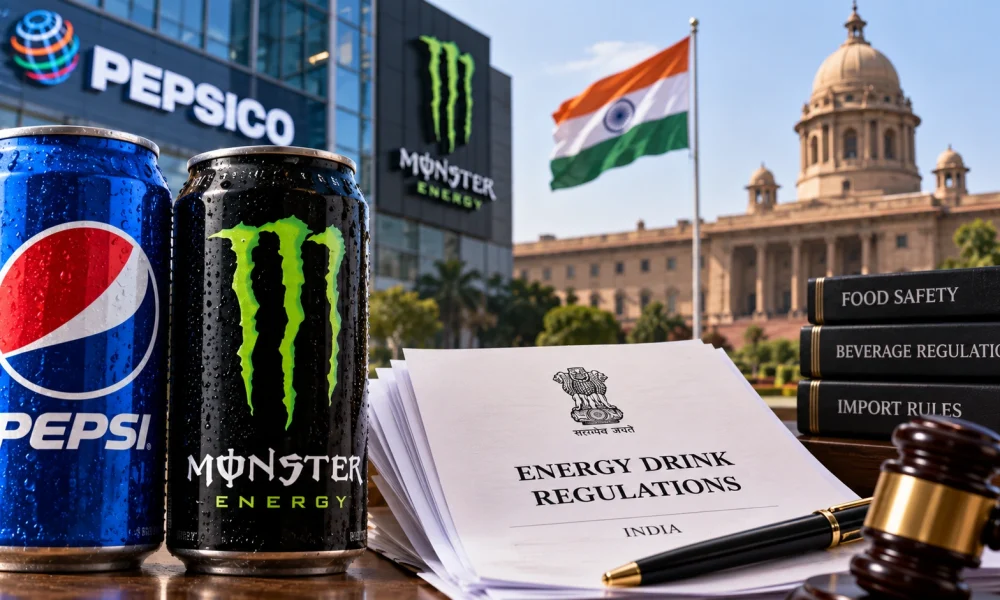
India’s rapidly expanding energy drink market is facing a significant regulatory dispute after PepsiCo and Monster Beverage challenged a decision preventing manufacturers from using the term “energy drink” for certain high-caffeine beverages.
The companies have taken legal action against India’s food safety regulator after the Food Safety and Standards Authority of India ordered producers to stop using the description.
The regulator introduced the restriction in June, citing concerns about products containing combinations of caffeine, sugar and taurine. The dispute is now heading toward the courts, creating uncertainty for major international beverage companies operating in one of the world’s fastest-growing consumer markets.
A rapidly growing category
India has become an increasingly important market for energy drinks.
Retail sales in the category are growing at an annual rate of around 12.6%, according to data cited by Reuters, with the market expected to reach approximately $1.6 billion by 2028.
The expansion has attracted both multinational beverage companies and domestic businesses.
PepsiCo’s Sting has become particularly visible in the market since its launch in 2017, offering a relatively low-priced energy drink that has gained popularity among younger consumers and in rural areas.
Regulators are focusing on product positioning
The dispute is not simply about packaging.
The Indian regulator’s position is that using the term “energy drink” on certain high-caffeine beverages conflicts with existing food safety rules.
Companies have argued that the decision has significant commercial consequences because large volumes of products already carry the disputed branding.
PepsiCo said in a court filing reviewed by Reuters that almost 492 million bottles and 26 million cans with the relevant labels were in circulation in India as of July 31. The company also argued that it had not been given sufficient opportunity to respond before the restriction was introduced.
Courts have already produced different outcomes
The regulatory battle is becoming more complicated because different companies have received different treatment through the courts.
A Delhi court recently set aside the regulator’s order against Red Bull, while another court temporarily halted the decision for Hell Energy.
PepsiCo and Monster are now pursuing their own legal challenges.
The cases could determine how India’s authorities regulate the marketing and classification of high-caffeine beverages across the broader industry.
A global debate over energy drinks
India’s decision reflects a wider international discussion about energy drinks and younger consumers.
Regulators in several countries have been examining the combination of caffeine, sugar and other ingredients used in these products.
In England, energy drinks containing high levels of caffeine will be banned for children under 16 from April next year.
The debate has increasingly moved beyond the question of whether consumers can buy these products and toward how they are marketed, labelled and positioned.
The business impact could be significant
For beverage companies, the terminology used on packaging is closely connected to consumer recognition and brand investment.
Changing labels across millions of bottles and cans can create substantial costs, particularly when products are already distributed nationwide.
Companies also have to consider advertising, retail displays and consumer awareness.
For India, the dispute is taking place at a moment when the country’s beverage market is attracting major international investment.
The final court decisions could therefore have implications well beyond PepsiCo and Monster.
They may influence how global beverage companies design products and marketing strategies for India’s increasingly sophisticated consumer market.
At the same time, regulators are likely to continue focusing on the balance between commercial interests and public health concerns.