Complexity Gaming Shuts Down After 23 Years as Esports Economics Come Under Pressure
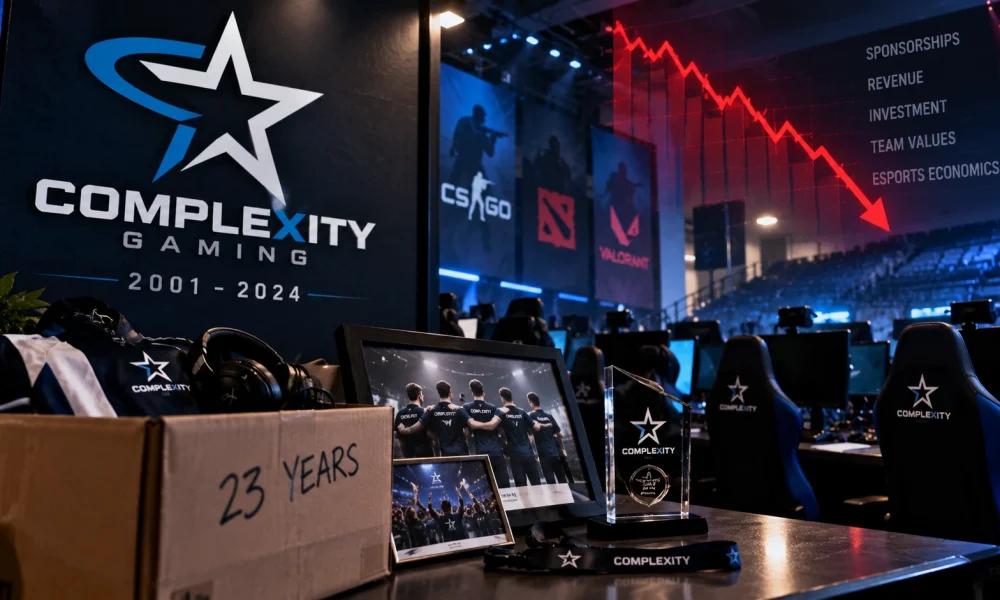
Complexity Gaming has ceased operations after 23 years, bringing an end to one of the longest-running organisations in North American esports.
Founder Jason Lake confirmed the closure on September 23, explaining that the decision had been made after evaluating the organisation’s financial position and its ability to raise the capital needed to continue operating.
Ownership of the Complexity brand and its intellectual property has returned to GameSquare.
A long history in competitive gaming
Complexity was founded in 2003 and became particularly well known through Counter-Strike.
The organisation competed in Counter-Strike for most of the following two decades and appeared at ten official Majors.
Its historical achievements include victories at ESWC 2005 and CPL Summer 2006, while the organisation later returned to the highest level of Counter-Strike competition with another generation of players.
The brand also expanded into games including Call of Duty, Rocket League, Apex Legends, FIFA and other competitive titles.
The financial structure became difficult to sustain
The organisation’s latest closure was linked to the difficulty of raising capital needed to settle a seller-financed note connected to Lake’s 2024 repurchase of Complexity.
Lake and an investor group had bought the organisation back for $10.36 million, with approximately $9.61 million of that transaction financed through a seller-held note from GameSquare.
When additional capital could not be secured, Lake decided to wind down the organisation rather than continue operating without a sustainable financial structure.
Counter-Strike had already become too expensive
Complexity had already exited Counter-Strike 2 in August 2025.
Lake cited the financial burden associated with operating a tier-one Counter-Strike team, reflecting a wider issue within esports.
Top-level competition requires significant spending on players, coaches, travel, facilities and support staff.
At the same time, sponsorship and media revenues do not necessarily grow at the same pace as operating costs.
For organisations without substantial outside funding, maintaining a presence at the highest competitive level can become difficult.
Complexity was more than one team
The closure is significant because Complexity had developed into a broader esports and gaming brand.
Across its history, the organisation accumulated more than 140 championships across nearly 30 competitive titles, according to reporting on the shutdown.
It also worked with creators and operated gaming communities beyond traditional professional teams.
The organisation therefore represented a model of esports business that combined competition with content, community and entertainment.
A warning for the wider industry
Complexity’s closure comes after several years of financial pressure across professional esports.
The industry has attracted substantial investment, but many organisations have struggled to translate audience size into reliable profits.
Some teams have reduced their competitive programmes, while others have exited individual games altogether.
Complexity’s history makes its closure particularly notable because the organisation survived several generations of games, business models and ownership structures.
Jason Lake’s next chapter
Lake has said that he does not consider his career in esports finished.
After stepping away from Complexity, he indicated that he intends to explore new opportunities in the industry.
The Complexity brand itself remains under GameSquare’s ownership, meaning its intellectual property still exists even though the organisation is no longer operating under Lake’s leadership.
The closure marks the end of a major chapter in North American esports.
It also demonstrates that longevity alone cannot guarantee sustainability in a business where competitive costs, investment requirements and revenue models continue to change.