International Hotel Groups Return to Syria as the Country Tries to Rebuild Its Tourism Industry
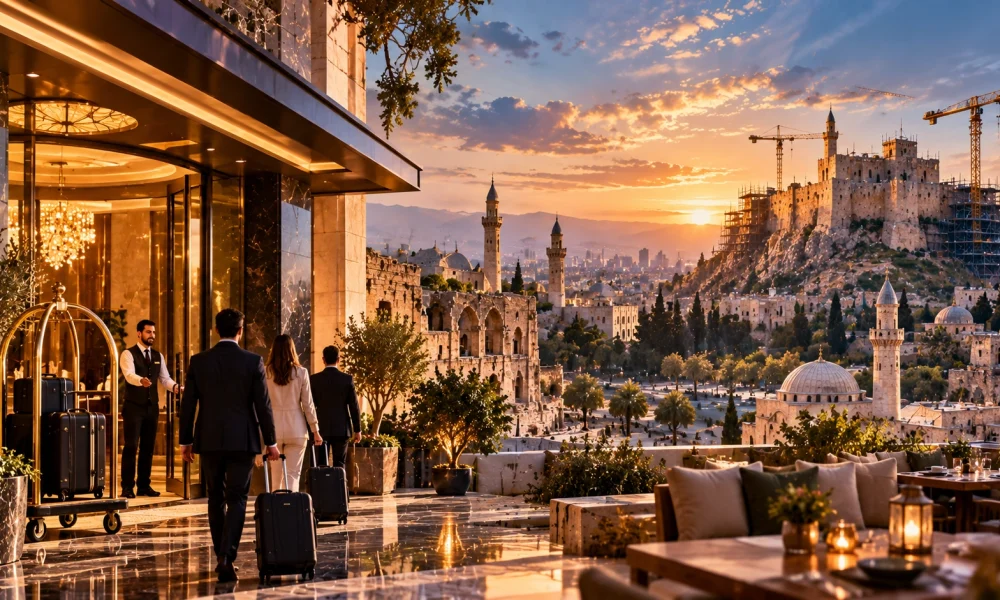
Several international and regional hotel groups are exploring entry into or expansion within Syria, a sign that the tourism industry is beginning to view the country as a potential reconstruction market.
Syria remains a high-risk destination, but the return of international flights and rising visitor numbers have created new interest in hotels, tourism infrastructure and property development.
According to figures cited by Reuters, Syria received around 3.52 million visitors during the first half of 2026, more than double the number recorded during the same period a year earlier. Most were Syrians living abroad.
Reconstruction is beginning to include tourism
After years of war, Syria needs massive investment.
Cities, roads, hotels and infrastructure have been heavily affected.
The World Bank estimates reconstruction costs at around $216 billion.
Tourism could become an important source of revenue if infrastructure and security conditions allow international visitors to return.
Major hotel groups are examining the market
Companies such as Accor and Wyndham are studying projects in Damascus and along the coast.
UAE-based Eagle Hills has signed a framework agreement for major developments in Damascus and Latakia.
One project announced in Damascus covers around 10 million square metres, while the Latakia development would cover approximately 4.3 million square metres.
These figures show that the interest is not limited to individual hotels.
Investors are thinking about large-scale urban developments and integrated destinations.
Air connectivity is essential
International tourism cannot recover without flights.
In recent months, connections with Gulf hubs have improved.
Qatar Airways and flydubai operate services to Syria, while Etihad has announced an increase in flights to Damascus to seven per week.
These connections could make the difference between an isolated tourism market and one connected to international travel networks.
History is one of the country’s biggest advantages
Syria has an extraordinary historical heritage.
Damascus is one of the world’s oldest continuously inhabited capitals.
Historic cities, archaeological sites and the Mediterranean coastline offer a rare combination.
For travellers interested in history and culture, the potential is significant.
The problem is infrastructure.
The risks remain substantial
The fact that hotel groups are exploring Syria does not mean the country has become an ordinary tourist destination.
Episodes of violence continue.
Infrastructure remains underdeveloped.
Electronic payments are limited in some areas.
Large investments may also face local opposition.
In addition, travel advisories issued by several governments remain cautious.
A long-term bet
For the hotel industry, Syria could represent a long-term project.
Investors are not looking only at today’s tourist numbers.
They are looking at a potential economic reconstruction.
If infrastructure improves, air connectivity increases and stability strengthens, the market could become one of the most interesting recovery stories in the regional tourism industry.
For now, however, Syria remains a market positioned between reconstruction and risk.
Hotel industry interest is an important signal, but it is not yet proof that international tourism has returned to normal.