Wall Street’s IPO Market Loses Momentum as Investors Become More Selective
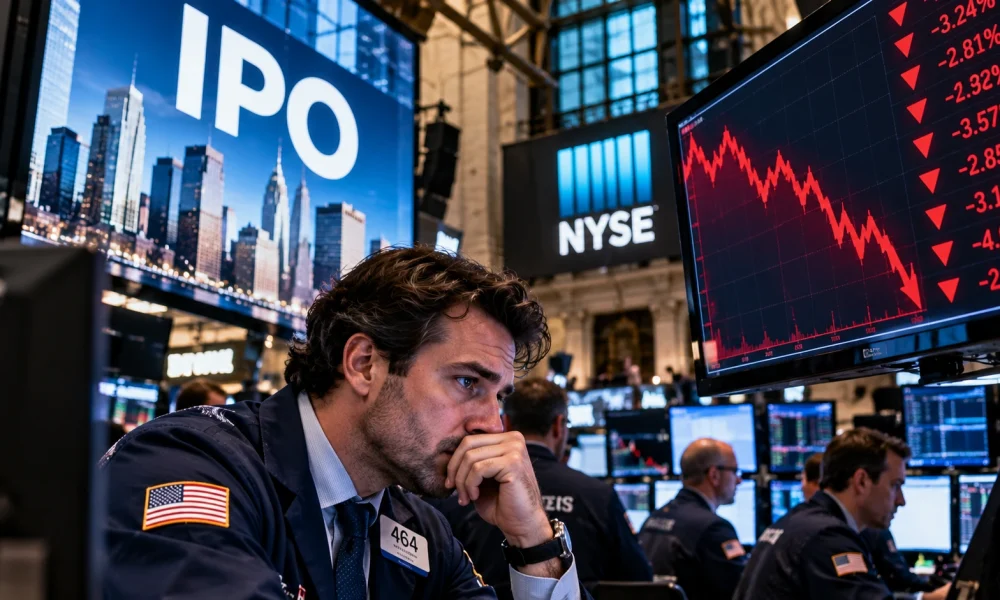
The US initial public offering market is entering the final quarter of 2026 with significantly less momentum than investors had expected.
Several companies have delayed or paused planned listings as investors become more cautious about valuations and the sustainability of the current technology investment cycle.
The Financial Times reported Sunday that companies including EG Group, Holtec, Oura, SB Energy and Bamboo Insurance have recently postponed IPO plans.
Investor enthusiasm has weakened
The IPO market had been expected to become one of the strongest parts of the US equity market during the second half of 2026.
Instead, investors have become more selective.
Concerns about high valuations are particularly strong in technology and AI-related companies, where expectations have risen rapidly.
AI remains at the centre
Anthropic is one of the most closely watched potential listings.
The company is expected to pursue an IPO at a valuation above $2 trillion, but its planned timing has reportedly moved toward November.
OpenAI has pushed its own potential public offering into next year.
The delays highlight the difficulty of bringing extremely highly valued private companies to public markets.
First-day gains are no longer enough
Investors are increasingly looking beyond the initial market reaction to an IPO.
A company may generate strong demand on its first trading day, but shareholders ultimately need evidence that the underlying business can generate sustainable profits.
That has made investors more cautious about companies whose valuations depend heavily on future growth.
Global uncertainty adds pressure
The IPO slowdown is also occurring alongside volatility in energy prices, government bond markets and global economic conditions.
Higher borrowing costs can make growth companies less attractive because investors place greater value on current earnings.
A more disciplined market
The current environment does not mean the IPO market has disappeared.
It means companies now face a higher standard.
Businesses preparing to go public increasingly need to demonstrate clear revenue growth, credible profitability and realistic valuations.
For investors, the return of discipline could eventually create a healthier IPO market, even if it means fewer companies reach public markets in the short term.