Another air traffic control failure disrupts UK flights and raises fresh questions about aviation resilience.
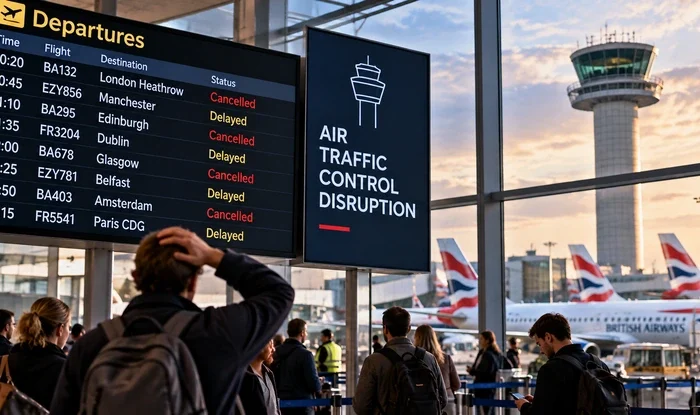
Travellers across the United Kingdom faced another wave of flight delays and cancellations in September after a new technical failure at the country’s air traffic control provider disrupted operations at several airports.
The incident occurred on September 21 at the National Air Traffic Services (NATS) control centre in Prestwick, Scotland. The problem affected connectivity within part of the organisation’s systems network and caused disruption across Scotland, Northern Ireland and northern England, with knock-on effects reaching other airports and international routes.
The latest failure was particularly significant because it came less than two weeks after a separate and much larger technical incident had already caused widespread disruption across the UK aviation system.
For passengers and airlines, the timing has turned what might normally have been treated as an isolated technical problem into a wider question about the resilience of Britain’s air traffic infrastructure.
A problem at Prestwick quickly spread across the network
NATS reported that the latest incident was caused by a connectivity issue affecting part of its systems network at the Prestwick control centre.
Although the problem was resolved during the morning, the consequences continued throughout the day because aviation networks cannot immediately return to normal after traffic restrictions are introduced.
When aircraft are delayed or cancelled, crews and planes can end up in the wrong locations. Gates become unavailable, connecting flights are missed and airports have to manage aircraft arriving outside their original schedules.
That means even a relatively short technical problem can create disruption that lasts considerably longer than the initial failure.
Cirium data indicated that more than 200 flights had been cancelled by later in the day, with Manchester, Edinburgh and Belfast among the airports significantly affected.
Glasgow and other airports also experienced delays, while airlines including British Airways, easyJet, Jet2 and Ryanair reported consequences for their operations.
The disruption was eventually brought under control, but passengers were warned that delays could continue because of the backlog created by the interruption.
The second major failure in just two weeks
The latest incident would have been serious on its own, but its significance increased because of what had happened earlier in the month.
On September 8, a separate problem at NATS caused widespread disruption across the UK. More than 2,000 flights were delayed, cancelled or diverted, according to the Civil Aviation Authority.
NATS subsequently confirmed that the September 8 incident had been caused by a software defect in a specific part of its flight data system.
The defect corrupted flight information and forced restrictions on air traffic while the system was recovered.
The organisation said the problem was unrelated to the major NATS outage of August 2023 and was not caused by a cyberattack.
However, the fact that another technical problem occurred within days of the September outage immediately raised concerns among airlines and passengers.
The two incidents were not caused by the same technical fault, but their proximity highlighted the consequences of relying on complex digital systems to manage one of Europe’s busiest airspaces.
Airlines demand greater reliability
Airlines have responded with increasing frustration.
Ryanair said more than 25,000 of its passengers were affected by the September 21 disruption and renewed its criticism of NATS management.
EasyJet and British Airways also raised concerns about the reliability and resilience of the UK’s air traffic control infrastructure.
For airlines, the issue goes beyond individual delays.
A flight that cannot depart on time can affect several subsequent services. Aircraft may arrive late at their next destination, while crews can reach the limits of their permitted working hours.
The result can be a chain reaction that continues long after the original technical issue has been fixed.
Airlines also face additional costs when disruption occurs, including passenger assistance, accommodation, aircraft repositioning and operational changes.
The wider financial consequences can therefore be considerably larger than the direct cost of repairing the original technical problem.
Why air traffic control failures have such a large impact
Modern aviation depends on an enormous amount of coordination.
Air traffic controllers need accurate information about aircraft positions, flight plans, routes, altitude and available airspace. That information is constantly updated as thousands of aircraft move through national and international airspace.
When part of that system becomes unavailable, controllers cannot simply continue operating at normal capacity.
Safety comes first, which means traffic may have to be restricted while systems are restored or alternative procedures are introduced.
That is why a technical problem in one part of the network can have consequences far beyond the location where it occurs.
The Prestwick centre plays an important role in managing air traffic across Scotland and the surrounding airspace, including routes connected with the North Atlantic.
Restrictions in that area can therefore affect both domestic services and international flights.
Passengers may not receive compensation
For travellers caught up in the September disruption, another important issue is compensation.
The UK Civil Aviation Authority said passengers affected by the earlier September 8 NATS outage were unlikely to be entitled to standard compensation because the disruption was considered likely to fall under the category of extraordinary circumstances.
Airlines are nevertheless expected to provide appropriate care to affected passengers, including assistance with food and accommodation where applicable.
The distinction is important.
A passenger whose flight is cancelled because of an airline’s own operational problems may have different rights from someone whose journey is disrupted by a failure outside the airline’s direct control.
For travellers, however, the practical result can be similar: missed connections, additional expenses and uncertainty about when they will reach their destination.
Government scrutiny is increasing
The repeated incidents have also put pressure on the UK government.
Transport Secretary Heidi Alexander asked the Civil Aviation Authority to conduct an independent review following the September 8 incident.
On September 25, the regulator announced the scope of that review. It will examine NATS’ explanation of the original failure, assess the impact on passengers and consider what additional measures may be needed to strengthen confidence in the resilience of the UK’s air traffic management system.
That review is now taking place against the backdrop of the second technical problem.
The government therefore faces a broader question than simply establishing what went wrong on September 8.
It also needs to determine whether the UK’s aviation infrastructure has sufficient redundancy, monitoring and contingency capacity to prevent technical problems from producing large-scale disruption.
A warning for the travel industry
The incidents highlight a vulnerability that extends beyond Britain’s airports.
Airlines have invested heavily in modern aircraft, digital booking systems and increasingly automated operations. Airports have also become more dependent on technology for check-in, baggage handling, security and passenger processing.
Air traffic control sits at the centre of that digital ecosystem.
If its systems fail, the consequences can quickly spread across the entire travel chain.
The September incidents therefore offer a reminder that technological sophistication does not automatically eliminate operational risk.
In some cases, greater reliance on interconnected systems can make resilience and backup capacity even more important.
For the UK’s aviation industry, the challenge will be to ensure that a technical problem remains a technical problem rather than becoming a nationwide travel disruption.
What travellers should expect
For passengers planning to travel through the UK, the immediate advice remains straightforward: check flight status before leaving for the airport and allow additional time when travelling during periods of disruption.
The September 21 incident was resolved relatively quickly, but the effects continued because airlines needed time to restore aircraft and crew schedules.
That means a passenger whose airport appears to be operating normally may still face delays if their aircraft or crew was affected earlier in the day.
The broader issue, however, will not be solved by passengers checking their flight status more carefully.
The repeated failures have placed the resilience of the UK’s air traffic control network firmly under scrutiny.
The bigger question for British aviation
The UK has one of the world’s busiest and most complex airspaces. NATS manages more than two million flights every year, making reliability essential not only for British travellers but also for international aviation.
The September disruptions have shown how quickly problems inside the system can spread to airlines and airports across the country.
The latest incident was different from the software defect that caused the major outage earlier in the month, and there is no indication that the two failures had a common technical cause.
But for passengers and airlines, the distinction offers limited reassurance when two major disruptions occur within such a short period.
The independent review will now have to examine whether the individual incidents were simply unrelated technical failures or whether they reveal deeper weaknesses in the resilience of the UK’s air traffic management infrastructure.
For the travel industry, the answer could be just as important as fixing the individual faults.
Sources: NATS, UK Civil Aviation Authority, Reuters, Associated Press, Financial Times